Infectious Until Proven Celibate… seriously?

The deliberately discriminatory draconian blood ban is how Canadian Blood Services (CBS) chooses to kill people every single day. Their present policy states that men who have sex with men (msm) must practice total abstinence of sexual contact for three months to be granted the privilege to donate. This also applies to trans women who have not had gender affirming surgery who have sex with men. The ban ignores advances in screening which are now able to detect cases as new infections within nine days of exposure.

    PrEP, short for pre-exposure prophylaxis, is a drug which according to the CDC reduces the risk of contracting HIV from sexual practices by 99% as opposed to those not on the drug. This drug is heavily marketed at msm and trans individuals and apps like Grindr encourage its use by adding "on PrEP" as an add on to your HIV status option, where you can also add your last date tested. While none of these boxes are mandatory to fill out, it does support the information from the Unifor website stating that msm (and presumably trans folks as well) are more likely to know when they're been exposed that their heterosexual counterparts. Despite this CBS still refuses to make their questions related to behaviour, preferring to run on assumptions; a monogamous gay couple is not allowed to donate but a woman can ride a new disposable douche daily, provided she has a vagina, and still donate.

    It's pretty sad that the Umbrella Academy did a better job of discriminating blood donation based on behaviour of a man who has sex with men. It was based on behaviour. Imagine. But no, we instead are given the Luther treatment of having our blood being basically inhuman.

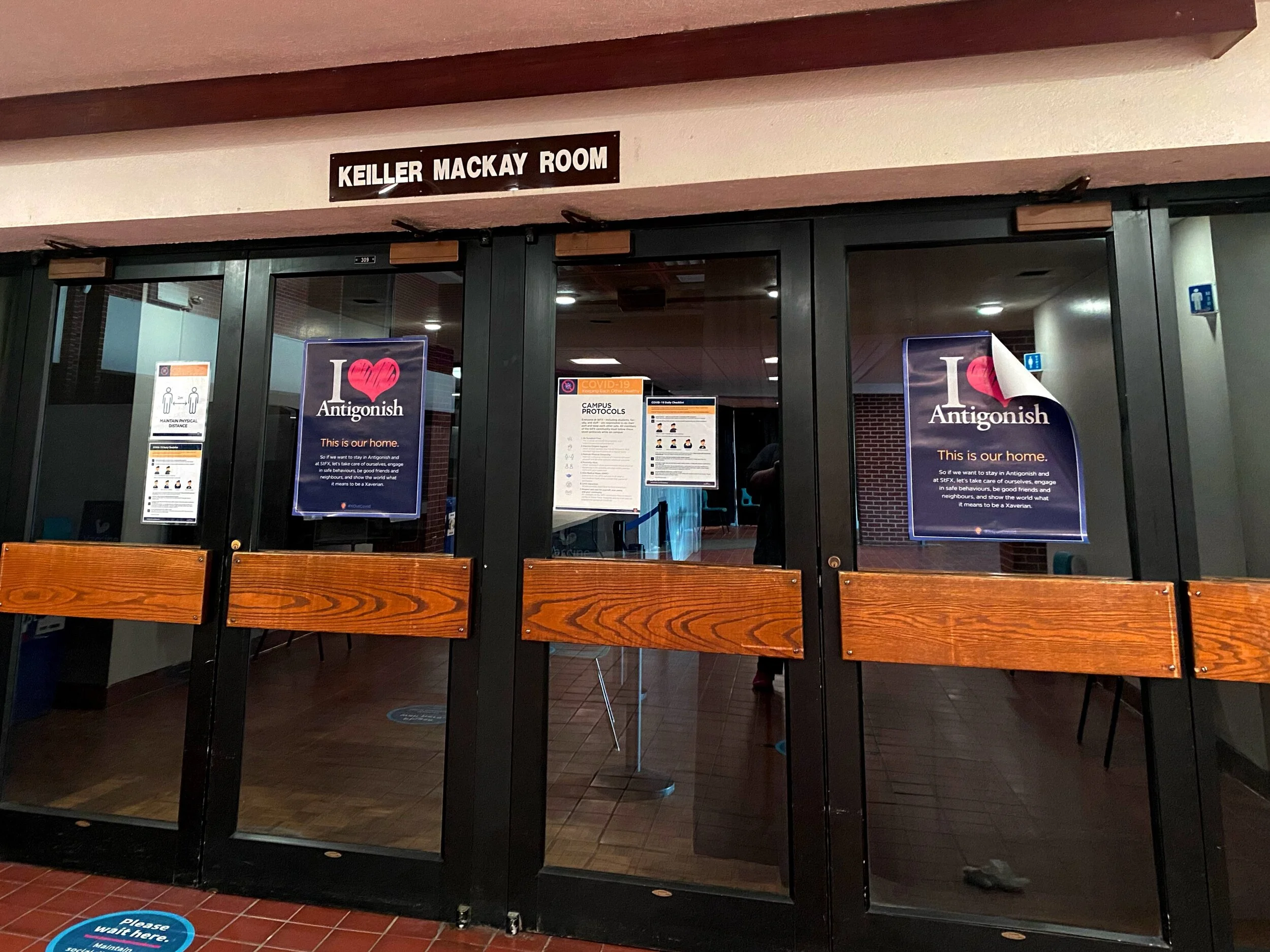
It's pretty obvious that people are just plain homophobic. Read the CBS frequently asked questions and try sifting through their political paragraphs for an actual answer to the question that doesn't boil down to "gay blood is dirty, we ignore science that doesn't support this." Having the Student Union Building choose to support this was disrespectful to every person who saw it had to laugh it off. Hatred based discrimination has no place in a build that's supposed to be for ALL students. Take the hate home. Ninian's Cathedral is an on campus location that isn't part of the campus itself, it's part of the community of Antigonish. A community which is far less likely to walk into the heart of campus to donate than they are to come from the sidewalk to donate. More donors and the school engages in a positive way with the town. Everybody wins and the place not for the gays is the church once more. If we can't have human levels of respect you can at least let us have a laugh.

Nobody should have to walk past a reminder of ignorance reducing them from a who to a what.

RBG's Mixed Record

Following the death of US Supreme Court Justice Ruth Badger Ginsburg and the online praise she was receiving, I became aware of a number of articles suggesting that Ginsburg in fact did not have a favourable record when it came to issues of Indigenous rights. The proposed ‘champion for all’, though instrumental in the assertion of women’s rights in America, had what some would call a ‘mixed record’ when it came to more intersectional feminist views.

I felt that it was important to look into the cases that make Justice Ginsburg’s record on Indigenous cases less than the caliber of judicial excellence that much of the public remembers. A quick search yielded results that I had not previously thought to look into given the widely publicized image of Ginsburg as the ‘Notorious RBG,’ the fierce fighter of women’s rights.

During Ginsburg’s tenure as Supreme Court Justice the opinions she wrote for the court regarding what are referred to as “Indian Law” cases were comparatively less favourable towards groups of Indigenous people than had been written in previous years. Ginsburg’s record upholds the opinion that she was unreceptive to indigenous claims. In hindsight, it can be inferred that the Supreme Court itself has shown preferential treatment to those enforcing state rights, rather than Indigenous rights or what is referred to in Carole Goldberg’s analysis of past Indigenous cases involving Ginsburg as ‘tribal rights’.

Ginsburg’s record is particularly interesting as it is her opinions that are the bigger issue, not necessarily how she voted in these individual cases, where scholars take issue. One such opinion which she wrote in regard to the City of Sherill V. Oneida Indian Nation frequently pops up as one of the more problematic. The case itself dates back hundreds of years, to the American Revolution. The Oneida had broken ranks with the other Iroquois Nations to support the US, providing the army with corn that was considered a much-needed resource at the time. Following the Revolution, in acknowledgement of their efforts, the US signed a treaty with the Oneida to provide 300 000 acres of land in what is now New York. Later, in 1970, New York pressured the Oneida into signing all but 5000 acres of their land away. The US never intervened, despite a 1790 law stating land could not be allocated without express permission of the US. By 1838, after more pressure from the state, the Oneida only owned 32 of the original 300 000 acres.

By the nineteenth and twentieth centuries numerous attempts to reclaim Oneida land were made. When the Oneida finally managed to reclaim a small part of their ancestral land, however, another issue occurred. Though Oneida was understood to be a sovereign nation, as the treaties that were signed outline, the City of Sherill was still imposing a tax on their land. When brought to the Supreme Court, the decision was rendered in favor of the City of Sherill, which lower courts have suggested acts as an invitation to deny Indigenous claims in the future. In Ginsburg’s opinion to the court, she consistently references the Oneida’s dispossession of land as ‘ancient’ rather than recognizing that their rights were being dismissed in the present. The struggle that the Oneida were currently facing was disregarded. As a historian, I find fault in the lack of understanding about the depth to which these issues persist, and the past in which they are connected to.

In more recent years, Ginsburg’s voting had been more favorable towards the affirmation of Indigenous Sovereignty. In one of her last votes, Ginsburg voted 5-4 in McGirt V. Oklahoma. This ruling affirmed that the eastern half of Oklahoma was considered Native American Territory. If anything, these facts point to a need to grapple with dissenting stories opposing a common public storyline. Ginsburg’s opinions to the court also outline a distinct gap in the law more generally when it comes to the understanding of

Indigenous traditions, law, and ways of understanding the world. Nearly nobody is untouched by an ingrained history of colonialist views. Ginsburg, though the pinnacle of women’s independence, lacked the capacity to understand the Indigenous perspective for much of her law career.

The Waiver: an Article on Complicity

​Dear X, 

​I knew this day would come. My story, my unique StFX experience, that made national headlines would one day feel meaningful to tell. Though my name was hidden I was the student Dr. Robert Strang was talking about, the student CBC was talking about, and the student my campus was talking about. I was the kid that beat meningitis twice. My Xaverian journey begins in 2014. 

 ​Like many of my peers I moved to Antigonish as a first-year student from Ontario. I had never lived away from home before. I was now to fend for myself in this new grown-up world. I adjusted and found a new home in Antigonish. I moved into residence, befriended my roommate, expanded social circles, participated in my classes as well as frequented the intramural sport arena. I was becoming someone, something I was unable to do back in Ontario. I was at peace. The safety and security I felt in my new home was beyond description. Then one night my peace was shattered. I found myself unable to hold down any food, water, or cold medication. I could not sleep, for the pain exploding through my spine was horrific. I felt like I was made of glass. My head was spinning, my eyes so sore I could not see very well and yet that afternoon I was happily sitting in meal hall. The symptoms appeared so quickly that by the time my roommate awoke on November 10, 2014, I was already dying. Once admitted to the regional hospital I began to deteriorate. Spinal fluid, blood samples, and stool samples all returned congruent with a horrifying discovery. I had contracted Bacterial Meningitis Strain-y. Immediately I was rushed to the ICU and the garments of people around me began to change. I was suddenly too sick to touch and or even share the unfettered air. I remember wondering If I would die alone before I was 20 years old. Would anyone even know I was dead? Then I blacked out. I awoke and my mother was beside me in a hazmat suit holding my swollen speckled hands. IV’s dotted my arms pumping me full of heavy medication. I was alive, somehow. I spent the next weeks attached to heart monitors, slow drips, and oxygen masks. I felt like I was rotting. I felt like my life was over. The comfy new home I had grown accustomed to had been ripped away and replaced by something cold and metallic. My new university friends came to see me, my new friends have supported me, my new friends have constantly been their for me, my new friends are everything to me. My new friends turned into my best friends but my best friends could not wait on their Xaverian journey for me. I lost my first semester but I survived the unthinkable. 

​I made the decision to return to my studies in second semester. I felt well enough and though my parents were skeptical I was determined to return to StFX. I agreed to a reduced course load and a different way of life. I was the student that beat the deadly disease that swept through the province. The first time I ever really heard tell of an outbreak was when it was used to describe my illness. I was ostracized despite my friends best efforts to keep my self esteem in check. Any and all conversations resulted in my struggle with the disease. Jokes were made at my expense by strangers who had no understanding of what kind of illness I just defeated. Upon my return to StFX one would think I was present the entire fall. I was not approached by any StFX resource to aid in my transition back to classes. I was not offered any refunds for the class I missed, the meals I did not eat, nor the nights I did not sleep in residence. I was forced to negotiate the exemption of my winter examinations. I felt alone and isolated by the university that made me feel so welcome. The one thing that infuriated me was that the university did not look into the outbreak on my behalf nor did they complete any precautionary measures to ensure something like this wouldn’t happen again. I was expected to just pick up where I left off thinking I was at least protected by my institution. 

​On January 28, 2015, I contracted a different strain of Bacterial Meningitis from the one I had less than two months ago. I almost died at the same University, in the same residence, from the same deadly disease. This time I was the boy who cried wolf. Not a soul on campus believed my cries as I lay crippled in my residence. The residence staff were hesitant to call the ambulance so they didn’t. By the time those around me realized my situation was deteriorating again there was no time to wait. I was put in the back of a taxi cab and rushed to the hospital again. My grip on reality was slipping. My body was failing me again. I found myself in a very familiar position second semester of my first year.  I was alone in a hospital wondering if I was going to die, I watched the scrubs of the medical professionals around me change from colourful shirts to hazmat suits, I watched watching IV’s and needles force their way into my veins and spinal fluid once more. My grip on life slipping away from my swollen hands speckled again, pockmarked by liver failure. I awoke to my family beside me. I awoke to my name being in the mouths of my peers as they circulated campus. I awoke but this time I had lost my will to fight anymore. I medically withdrew from StFX. I was lucky to be alive. 

​Upon my medical withdrawal I was offered barely 1/4 of my tuition, even though I missed 3/4 of the school year. I was not informed of any tests done by the university to understand the causes of the outbreak despite StFX’s name spattered across CBC. There was no attempt at acknowledging any accountability. I was just a number but I didn’t find that out until the end of my second year. 

​My second year was a mistake. Since surviving meningitis I had contracted three new ailments. I was diagnosed with Depression, Post Traumatic Stress Disorder, and debilitating anxiety. I was not ready for anything close to the cognitive levels required to participate in scholastics. I descended into a chaotic spiral. Nearly one year to the day of my contraction of Meningitis I mentioned my desire to take my own life. I couldn’t cope, I couldn’t keep up with school, I thought I would never be able to operate like I once did. I was visited by my residence  Hall director but nothing was done to help me. I made up my mind and ran from the building towards the highway that ran behind our residence. One of my closest friends followed me to the bathroom and watched me try and run to the highway. He stopped me, hugged me, and told me it was going to be okay. My friends took it upon themselves to sleep on my floor and they are the reason I am here today. If you are reading this, thank you. I decided to move off campus to a safe environment where I was surrounded by close family friends. Despite my feeling of safety I could not cope. I failed most of my classes and failed out. StFX was going to let it happen, no questions asked. I got my doctors to weigh in and fight for me to avoid the hefty academic expulsion. I was reinstated. 

​I am 25 now. I started my Xaverian journey at the age of 19. I am set to graduate this year. I am finally able to call an X-ring mine. I can finally say its over. I have yielded to the whims of time. I am no stranger to highly contagious diseases. I am no stranger to the sharp needles of the regional hospital. I am no stranger to being locked up in an ICU containment room. I am no stranger to Dr. Robert Strang. I am no stranger to StFX. So please hear what I say. Making students sign a waiver is insulting. It is insulting to the wonderful staff at X who make up this university. You have metaphorically cut away the life boats and forced them to go down with the proverbial ship. I cannot emphasize this enough; having to deal with medical complications alone in first year University derailed my life for nearly five years. The completion  of my studies is a testament to the support systems that have surrounded me. I cannot believe StFX is acknowledging the dangers of a return to campus. Your waiver may absolve you from legal trouble but this is direct act of dangerous complicity. Complicit just like back on November 10, 2018, when you sent out an email in regard to another Meningitis outbreak on campus. In the very same residence I nearly died in twice. How dare you demand anyone to sign a waiver and usher a student into a potentially harmful environment? Your lack of awareness to the dangers of highly contagious diseases has nearly resulted in the deaths of two of your students. 

​If I should be able to receive my X-ring in person or it is delivered through the mail I will be hesitant to put it on. The message you are conveying is that student well being can be summed up in a legal document. The message you are conveying is the deficit that the university has incurred is more important than one students life. The message you are conveying is that I am just a number. When I receive my X-ring and Diploma this year I hope that I will be able to look back fondly on the instances where the Xaverian values have made me a better person. I just hope that you will reconsider opening campus if this waiver is your ticket to a fall semester. I worry about the first years who might wind up in an ICU. I worry you won’t have their backs like you didn’t have mine. I worry that this is just a numbers game. I worry I fell in love with a University that practices a different sermon than the one being preached. Hail and… saying Health in this situation would be a bit redundant no? Get better X. 

With warmest regards,

The Former Patient Zero

Signing the COVID-19 Waiver: Is it worth the risk?


Our true character is revealed in times of crisis. For universities,the COVID-19 pandemic is one of the largest crises they have faced in recent history. Not only does COVID-19 threaten the safety of students, staff, and faculty, it also impacts a university’s bottom-line. Small universities such as St. FX rely significantly on students who not only pay tuition but also residence costs and meal plan fees. In this regard, the prospect of going fully online would be financially catastrophic for these small institutions. It is not a surprise then, that Mount Allison, Acadia and St. FX have all decided to re-open in the Fall, each with varying degrees of online-course delivery.

With re-opening comes a variety of risks for universities. In a Cornell study on small universities, researchers created three simulations to model COVID-19 spread. Even when eliminating sporting events, large classes and shared residence rooms, the virus still had multiple pathways in which to proliferate. Indicating that if COVID-19 enters the campus, it is likely that it will be passed on. While much is not known about COVID-19 and this is simply one study, it is worth noting that St. FX, being a for-profit institution, likely understands the potential risks of re-opening and has evaluated those risks against the benefits(mostly financial) from opening in the fall. 

It is for this reason that they want students to sign the waiver emailed on July 10, 2020, in order to be allowed on campus. In signing the waiver, students release St. FX from all liability in the event that student(s) contract COVID-19 and are harmed. In a lot of cases, this kind of waiver is standard. If you go to an amusement park and break your leg after falling off a roller coaster, the amusement park is not responsible for that injury if you have signed a waiver releasing them of liability. In this case, you have acknowledged that you understand the risks, and your relationship with the amusement park is not significant enough to indicate that it should have protected you beyond a certain level.

The relationship between universities and students are fundamentally different than the relationship between a private citizen and an amusement park. Universities are institutions that operate under a high-level of trust on the part of their patrons, the students. In other words, they have a fiduciary duty to take reasonable measures to protect them. In some circumstances, if they haven’t taken reasonable measures to protect students, they can be found to have breached their duty of care or to have acted in a negligent manner in court and may be ordered to provide compensation. Under this waiver, they ask students to waive their right to sue the university for negligence or a breach in their duty of care, in exchange for students’ ability to go on campus.

So, what does this mean? Primarily, it means that St. FX expects to students to spend thousands of dollars in tuition and other costs but is unwilling to take responsibility in law to reasonably protect students from the risks of COVID-19. Students are asked to agree to the statement: “I understand that I may be infected by COVID-19 as the result of negligence on the part of the Releasee (St. FX).” Indicating that rather than take reasonable responsibility for the risks involved in reopening, and possibly purchase insurance, St. FX has decided to transfer the risk involved to the student body.

Further, students are asked to agree that in entering in the “Release Agreement” they are not relying on any “oral or written representations” made by St. FX with respect to the safety of participating in St. FX activities, or being at St. FX, other than what is set forth in this “Release Agreement”. Meaning that under the law, St. FX does not have to follow their own COVID-19 Pandemic Plan in order to mitigate risks, and that students need to indicate that they do not expect them to. In other words, the university has not put their money where their mouth is, in that any plan St. FX creates to respond to COVID-19 has no legal value.

What’s most significant is that St. FX has unbalanced bargaining power in this circumstance. For a lot of students, missing a year of school is not an option, leaving them vulnerable. Further, other than in the waiver itself, St. FX has not indicated the legal gravity of signing to students. Administrators, at the very least, should explain in plain language the rights students are giving up when signing.

It is important to stress that type of contract is not required. The university can create a waiver that obligates them to take reasonable steps to prevent harm to students, and in the event of circumstances they could not prevent, they can ask to be absolved of liability. This would be a fair contract with students and reflect the responsibility that administration needs to undertake in their decision to re-open, when other universities have not.

The COVID-19 waiver stands in direct contrast to the consistent messaging by the university administration on working together as a Xaverian community to ensure safety for everyone. If the university will not obligate itself to take reasonable measures to ensure safety for students, how can it expect students to do the same?

 Given this information, the question before students is if they should sign. It is unclear what the repercussions would be if not signing. St. FX indicates in their email to students on July 10, that they will not be allowed on campus. How will that be enforced? Will students not be able to attend class? It is also unclear if the university is legally allowed to prevent an individual from receiving higher education on the basis that they do not sign this waiver. 

 If you are a student who believes that the university should take reasonable steps to prevent the spread COVID-19, and that if they do not they should be held accountable in court, think twice before you sign.

Travel Advice and Lessons Learned from an Unqualified Teenage Travel Guide

Travel Advice and Lessons Learned from an Unqualified Teenage Travel Guide

From February 14 to 22, I travelled with my family on vacation to Europe. I will not pretend to be an expert in anything besides procrastination, so do not refer to me as you might Rick Steves—these are just some things I learned and enjoyed while on the trip!

Read More

StFX Peer Support Program to Launch on January 6th

StFX Peer Support Program to Launch on January 6th

Starting Monday, January 6, StFX students will be able to access in-person active listening and resource navigation services offered by students, for students on Mondays and Fridays in Bloomfield 417.

Read More

The DNA (Development of Natural Resources) of the St. Mary’s River Valley: Reflections of OOG (old old guide) & AWOC (a wise old crow)

The DNA (Development of Natural Resources) of the St. Mary’s River Valley: Reflections of OOG (old old guide) & AWOC (a wise old crow)

John Cameron is a member of the Class of '67, former Director of Development at 'X' and the Founding President of the St. Mary's River Association. This article was submitted in response to a letter from Sean Kirby that the Xaverian Weekly published on November 19, 2019. 

Read More

Atlantic Canada vs. Atlantic Gold

Atlantic Canada vs. Atlantic Gold

Many environmental interest groups have expressed their concern with the selected mine site with respect to its contribution to climate change and its compounding threat to several already at-risk species in the area—most prominently, the Atlantic salmon. 

Read More

Backyard Astronomy

Seeing double is never a good thing and a sign to seek medical attention; however, double stars can be a thing of beauty. Some stars that appear as a single point of light to the unaided eye are in fact, double when magnified with binoculars or a telescope. Optical doubles are two stars that appear close together only by line of sight with no physical attraction to each other. Visual binaries are two or multiple stars that physical orbits each other taking a few days to years to complete an orbit.

2019 - 10 image 1.jpg

If the geometry is just right, one of the binary stars passes in front of the other and we can see a lowering of the overall brightness for a short time period. These are eclipsing binaries such as the star Algol, the Demon Star, located in the constellation Perseus located in the North East. With binoculars and a bit of practice, you can witness the subtle change in brightness every 2.8 days as the main star dims for about ten hours.

Stars come in an array of colours and can be quite evident in some doubles. Their colour is an indication of surface temperature as all stars burn differently. On the left side of the spectrum, we have the hot blue and blue-white stars that burn at more than 30,000 degrees Celsius. The scale then moves down to green, yellow, orange to the far right side where we find the cooler red ones burning around 2,500 degrees Celsius. For reference, our sun is a yellow star with a surface temperature of 6,000 degrees Celsius.

2019 - 10 image 2.jpg

One of the best examples of contrasting colours in a double is the star Albireo found at the head of Cygnus the Swan now located in the North West sky. Using a telescope operating at 60 power, you will see a bright golden-yellow star next to a dimmer blue sun. The two are about 430 light-years from Earth and might take as long as 100,000 years to orbit each other.

2019 - 10 image 3.jpg

Since these are points of light and not faint galaxies or gaseous nebula requiring dark observing sites away from light pollution, double stars can be enjoyed from the city or suburb. Sometime the beauty and challenge is to split the close together; high magnification might not even separate them into individual components. And no two doubles appear alike but seeing them with your eyes is a unique experience.

Till next time, clear skies. 

Known as “The Backyard Astronomer”, Gary Boyle is an astronomy educator, guest speaker and monthly columnist for the Royal Astronomical Society of Canada. He has been interviewed on more than 50 Canadian radio stations and local Ottawa TV. In recognition of his public outreach in astronomy, the International Astronomical Union has honoured him with the naming of Asteroid (22406) Garyboyle. Follow him on Twitter: @astroeducator or his website: www.wondersofastronomy.com


An Open Letter to the Students of StFX University

I am hard-pressed to believe that my time as Students’ Union President has come to an end. Even as I write this, I still expect to receive emails sent to an account that is no longer in my name, telling me about the next problem that needs to be resolved. Similar to the ones who came before me, now that I have reached the end, I find myself looking back on everything that was achieved.

The Executive Team and I were determined to accomplish many things on behalf of our students, but most importantly we were determined to do our best for them, every single day. In light of recent events, I can perhaps say that a number of us on the team are leaving with mixed feelings. I do not presume to speak on behalf of my team, but for me, there were moments in this year that felt like something out of a film.

As President of the Students’ Union, I felt strongly that it was my responsibility to uphold the dignity of my office. I was aware of my position as a highly visible member of both the Union and the school; I never wanted to do something that would reflect badly on either of these institutions. However, it was challenging to say nothing as I witnessed behaviour and comments in the second half of my tenure that were exceptionally problematic and also representative of a larger rhetoric that has in recent times, penetrated university campuses.

I will begin by stating that I am very conscious of the power of words. This is not only as an outcome of my background, but also because of the effect of a very different type of letter that I wrote around this time last year. Words have the power to harm, to heal, to blind, and to reveal. These revelations might be about you or about others. Most importantly, in all of these instances, words have the ability to impact. As someone who interacts with different systems of oppression in my every day life, I have witnessed how words can be used to subjugate and stifle, or to liberate and free. For this reason, I am very careful with how, where, and when I use my own words. I will state that awareness of my words further increased in my time as President because it was part of my job to speak on behalf of over four thousand people.

In our childhood, we are taught that honesty and telling the truth are important values. As we get older, we begin to choose what is important to us personally and how we will uphold these values. From my perspective, truth and honesty are imperative for the position of leadership that the President holds. Students pay for the operation of the Union and vote to choose the representatives of the organization. Therefore, students have a right to know what happens in the Union each step of the way. In fact, it is the duty of students as constituents to ensure that their elected leaders are doing what they said they would and are making decisions that uphold the democratic processes of the institution.

If students have deemed that their representatives are not performing the jobs they were elected to do, then students have the inherent ability to remove these individuals from their positions. The Students’ Union, similar to other democratic institutions, has checks and balances that are intended to ensure that no one person has the ability to do what they want without repercussions. All students need to do is ask for the information about these processes and it shall be given to them.

The checks and balances in a democratic institution include a healthy Fourth Estate. It is the job of news and media to investigate different situations and offer analysis to help the reader gain perspective. While holding a position of leadership, it is expected that a person will receive criticism at any time. Open criticism of institutions and leadership are one of the best indicators of a strong democracy. These criticisms hold leaders accountable for their actions and ensure that the operations of a given democratic body shall fulfill their intended purpose. This is why the autonomy of the press must be protected and held at the highest regard. As students participating in a democratic process, you do not have to be afraid of offering criticism or of speaking the truth, regardless of the threats of lawsuits and promises of anger that may follow.

In addition to my reflections about the presidency and the Students’ Union, I would also like to offer my thanks to everyone who contributed to making this year so incredible.

I will begin with my Executive Team; Tiffany, Tega, Kallie, Clancy, and Sean, I never imagined that I could have a team as great as you. Tega, your wisdom and resilience have been nothing short of awe-inspiring to all of us. Kallie, your humour and ability to offer an objective perspective always kept us grounded. Clancy, your determination and compassion reminded us to be kind to one another. Sean, your creativity and ability to bring people together kept us close. Last, but never least, to my wonderful VP Academic, Tiffany. Thank you for being my right-hand, confidant, and close friend. When we were both elected that cold, January night in 2018, I never thought that I would gain such a beautiful friendship and partner-in-crime/all-things-theU. You and I will always be “the throat-puncher and the politician” respectively, as we were once humorously described.

I would also like to give a warm thank you to Tanaka, our fantastic Chair of Council. In our organization, the positions of President and Chair of Council are set up to have a complicated relationship. I think you and I were truly able to turn this belief on its head. I could not have asked for a better Chair, you led with grace, strength, and an uncanny ability to keep calm, even when everything went wrong.

There are so many people who have contributed to the Union beyond just the ones I have named here. Thank you for everything you contributed and for all that you did for our students.

Finally, I would like to thank you, the students of StFX University. You have treated my team and I with kindness, trusted us to do the right thing, and supported us in a way we had never anticipated. In all of our decision-making, at the end of the day, we were always faced with answering just one question. “Is this in the best interest of our students?” If we could see that something was not, we changed the circumstances; we searched for new information, we asked for advice, we looked at best practice, and we discussed and disagreed. All this was with the objective of ensuring that we were making the highest quality of decisions for our students. You were our motivation for pushing StFX to be the best place it could be. By electing us, you trusted us with the great responsibility of representing your voice; this was not a task that any of us took lightly. Thank you, for believing in us and for giving us -for giving me- the opportunity to serve you, the students.

Sincerely,

Rebecca Mesay

President

StFX Students’ Union


Why Do People Avoid Canadian Blood Services?


Friendly reminder that it’s in you to give

Most of us have probably heard or seen an advertisement to donate blood to Canadian Blood Services (CBS), especially when demands are critical; however, given only 1 in 60 Canadians choose to donate blood, why do other Canadians avoid CBS like the plague?

One of the most common concerns when it comes to giving blood are needles and passing out. Those who have trypanophobia tend to shy away from giving blood or even getting tested for their blood type, which is a bit of a harder hurdle to get over. For those that worry about passing out due to the amount of blood they’re giving, CBS has minimum weight requirements in place and snacks around to maintain blood sugar levels to avoid that very situation. If you’re prone to fainting at the sight of blood in general, it’s a bit harder to avoid passing out unless you don’t watch the entire process of blood donation.

Others cite not being aware of where or when blood donations are occurring. It is very easy to find this out information by visiting the CBS website or calling their number at 1-888-2-DONATE. Most donation dates and places are at easily accessible areas and times; there are often convenient blood drives on university campuses and at community hubs. For those that say they haven’t donated blood because they’re never asked or invited to donate somewhere, remember that it’s not only up to CBS to get you to the donation locations.

Some individuals chalk up their lack of blood donations to not having the time or just avoiding it altogether. For those individuals, it’s key to offer incentives such as having rewards for donating a certain number of times or being a first time donor. While CBS does offer pins and certificates for certain levels of donations, it may be worth investing a little money into short campaigns that give out things like $5 gift card. Of course, these types of initiatives appear more like bribery in exchange for blood, when blood donation should be more of an act of altruism.

Medication and chronic illnesses can also be barriers to donating blood. I’m sure there are other individuals like myself that were unaware for years that they could donate blood even while taking medication for a chronic illness. This is why being aware that CBS has a detailed list of medications or medical conditions online that do or do not hinder your ability to donate blood is incredibly important. Otherwise, some eligible donors may avoid donating blood altogether just because they’re not sure they won’t be rejected at the door for taking a particular medication.

Restrictions on how long you have to wait to donate blood after getting piercings and tattoos may also be discouraging younger people to donate. Individuals have to wait three months after getting a tattoo or piercing to donate due to the risks of infection associated with both, which is an important reason to wait to donate blood. However, approximately 36% of Canadians aged 18 to 34 have tattoos based on a 2012 study, younger generations may be showing up less to donate because of blood donation requirements around tattoos. Perhaps if CBS increases awareness about the restrictions, they might catch potential young blood donors before they head to an appointment for their next piercing or tattoo.


Photo: thethunderbird.ca

Photo: thethunderbird.ca

If you are a man that has sex with men, CBS requires you to wait a year since your last sexual contact with a man to donate blood. The blood ban hits gay men disproportionately since it automatically excludes those who are sexually active or in long term relationships. It also perpetuates the stigma of HIV/AIDs in the gay community, even though you can get HIV/AIDs if you are in a heterosexual relationship. Given that the proportion of individuals that identify as LGBTQIA+ is increasing among younger generations, the CBS should consider changing their donation rules related to men who have sex with men so they don’t lose a lot of eligible donors in the future.

There are many reasons why people avoid donating blood, most of which can be remedied by increasing awareness around restrictions to donating blood, how to get involved, or providing more incentives. CBS should also consider that they may be attracting less of the younger generation due to the rules around donating if you get tattoos, piercings, and men who have sex with men. In the end, I would still urge all of you to look into donating blood and to donate if you can.


Soyez Prudent


How do we preserve French culture?

I am a former French immersion student, and have no French background, no ancestry rooting back into the first Acadian settlers of Nova Scotia, no ties to the French. Meanwhile, I am concerned for the state of French within our province and across our country, given that French is an official language of Canada and it was a path I chose to continue to study. The culture, from as far as I can see, is slipping.

The French are classically portrayed as beret wearing, ascot sporting, baguette eaters with a hint of poutine on the side, but the French have a much richer ancestry. Many of your favourite dishes likely came from French cuisine, a huge component of the arts was inspired by and produced by the French, and, of course, they are responsible for creating the language of love. Canada often advertises itself as a bilingual nation, but short of direct interactions with Quebec or France, I see little to no promotion of French by the government. This could be due to the fear of the Québec and their separatist desires, but if anything, the promotion of French across the country would discourage such a move.

During my work placement last year, it was brought to my attention that there was a high demand for French teachers in Halifax, even as far as the end of September. The doors began to swing wide, accepting people with minimal French backgrounds as educators for those who wish to pursue it. That’s a problem. If people who are not well versed with the language are being hired on to instruct others, we immediately see a major decrease in student ability and comprehension, unless students take the initiative themselves. While I love the idea of maintaining the French program, it should not be kept or promoted if it isn’t going to be strong and well-run.

Moving to the local French, the Acadians cultivated the land and developed strong irrigation systems that have been adapted to use in the modern day. Many of the art pieces (the stars you see on so many homes across the province as an example) and structures we see across Nova Scotia are adaptations, if not direct representation, of the Acadians, and while there are museums and hot spots for Acadian culture, unfortunately there is little to no funding, and upkeep and maintenance is lacking. The understanding behind these symbols is also being lost, the star being a direct representation as the household being Acadian and not just French, but many people see it as purely design. There are some reports out there that suggest the star was the French equivalent to a wind chime in that it was believed to protect homes from evil spirits, but that could be individual beliefs rather than representation of the Acadians at large.

There was recently a panel on how to protect the Celtic heritage at the Bauer, but I think the same conversation needs to be had with French. Yes, it isn’t as discouraged or oppressed in our region such as that of others, but it is not immune to the greater powerhouse that is English. To paraphrase my mother, she used to tell me events only carry the weight that we give them, which to me is symbolic of what we value. Is age of greater value than the expulsion of the Acadians? We certainly seem to prioritize and celebrate birthdays far greater than moments in history. How about the Congrès Mondial Acadien? A large festival that I can’t say I had heard of prior to this article. I believe my mother’s statement can also be applied to all aspects of life. What do we give weight to?

To fix this issue, I think there should be a greater emphasis on addressing the problem in the first place. With the decreasing number of professionals entering the system to promote French, and an increasing number of students enrolling in Immersion, there is an imbalance. If French were something to be promoted through business, or with incentives, that could encourage the use on a day to day level. There is always a lot of talk on what French can get you and where it will take you down the line, but in my experience, French has only increased my employability minimally. 

On a personal note, a friend of mine recently underwent testing to see if she qualified as bilingual for the government and while she did not attain the highest level, she did do well; however, she could not hold a conversation with me. Now I’m not saying I have great French, but I know that I can hold a conversation with first language French speakers. My personal experience leads me to believe that our system is corrupt and that we should be addressing the issues. 

If somebody doesn’t do well on the test, that doesn’t mean you can’t hire them, but instead (particularly within the government) offer courses. Recognizing that development of Canada was in large due to Acadians should have been something addressed in the Canada 150 celebrations. There is a lot of talk about the indigenous populations and rightly so, but French became an official language for a reason, and it is seldom addressed.

I am here to say I want more. For some in the country, French is still the only language they speak. French within a community has always been accepted, unlike other languages, but if we fail to embrace it, we risk losing it.


The Battle of Coffee


The best coffee in Antigonish for the friendliest student price

Now, before I start, I must add that I am not a coffee expert and I do not claim to be one. This is just my guide to the best cup of coffee in Antigonish. I’ve been living in Antigonish now for four years, and I think I’ve cracked the code on what places sell the perfect cup, at the best price.

Finding the perfect cup of coffee can be really hard, but once you find that sweet spot that makes the perfect cup, it’s hard to let go of it.

I never used to be a coffee drinker before coming to university, imagine that. Even in my first year I prided myself in not needing any aid in the morning to get my system going. However, now that I’m in my fourth year I can guarantee you that by the middle of second year I became a loyal coffee drinker. I’ll admit, I hated it at first, but the late night of paper writing was not kind to me, so I used to just drink the coffee while secretly despising it. Now that I like the taste of coffee, does that make me an adult?

Alright, so let’s get started. Right off the bat, I’m sorry to all the loyal Tim Horton’s drinkers, but that coffee isn’t even in the top five of good coffee, it’s watery dirt. There, I said it. As for McDonald’s, you are not bad. If I had to pick between the two of you for a place to get coffee I’d have to go with McDonald’s without question. I see you, but you do have room to improve.

I’ll start with Pachamama. Now, I am a big fan of this little but blossoming spot. The food and snacks are delicious and vegan, gluten-free, and dairy-free friendly! Big win in my books, coming from someone who has celiac disease. As for the coffee, it’s not bad coffee to say in the least instead it just does not mingle well with my taste buds, also the price isn’t too friendly to my tight student budget I’ll be honest.

Oh, Tall and Small, you own my heart, but not precisely my coffee heart. I should correct myself; your drip coffee does not hold my heart. But! Your latte’s, well that is another story, I am a devoted latte customer at the T&S. If you ever really want to treat yourself with any specialty coffee latte, cappuccino you name it, then Tall and Small is your answer. Plus, Collen and Leah (shout-out) make some wicked coffee art with a kind smile. For someone who operates on a student budget, I must admit to spending too much money on lattes.

So, the moment you’ve all been waiting for, who’s the coffee winner? It’s Sodexo coffee! I’m just kidding, far from. It’s the Waffle Bus! This may come across as a surprise, but I mean should it? It’s no secret that this place makes some of the best food in town, so it’s only natural that their coffee is also the jackpot. It’s so smooth, and always piping hot, I recommend going with the light roast, plus they have brown sugar to put in your coffee, it’s a game changer. Plus, if you bring in a reusable mug, it’s only $1.50, saving the planet while also fixing your coffee needs for a great deal.

Like I said before, I am by no means a coffee connoisseur, but four years of testing out new places in the nish, I think I found the perfect spot. By all means, you can disagree with my top coffee. Before you do, test out the Waffle Bus’s coffee. Who knows, you might agree.


Living at the End of Time


A critique on capitalism in popular culture

The collapse of competing economic ideologies by the 1990s, led to the supremacy for an invisible ideology; it believed only in the power of markets, it dissolved our future, and created an existential ennui that has left many of us disjointed from time and alienated from ourselves and our environments. In the video  essay, “Hypernormalisation,” Adam Curtis includes a brief clip from an interview with a Russian woman during the late Soviet era. The interviewer asks the woman what her dreams are, she replies, befuddled, “what are dreams? What purpose do they serve?” For Curtis, this is symptomatic of the late Soviet Union, the stagnation of communism produced an existential ennui. 

The dreams of scientific Marxism had failed to produce a futuristic, stateless utopia and instead created an oppressive state capitalism that had reduced their lives to little more than ensuring that numbers increase on production charts.

The end of Soviet expansion, the misadventures in Afghanistan (itself a prophetic omen for American imperialism), economic decline, and creative stagnation would come to give Western leaders a false sense of triumph and victory. It will also foreshadow our own creative stagnation that has cast a spectre over the world, which is Capitalist Realism.

With the fall of the USSR in 1991, Francis Fukuyama predicted the “end of history,” understood as the struggle of one civilization against another and the conquest of a single world order. In this vision of the future, liberal democracies would spread to country after country, and would usher in a coherent and copacetic, global vision of economic and political philosophies. Pilloried at the time and even more so after 9/11, various criticisms were levelled at Fukuyama, most popularly that “Western Civilisation” was at war with a new global power, Islam. Media outlets, desperate for a new boogeyman, and with the help of American intelligence agencies, manufactured a single, imperial entity out of numerous disparate factions all claiming religious inspiration. According to these theorists and media personalities, instead of “ending” history, we were being ushered into a new era of clashing civilizations; Islam versus the West. However, they were quite wrong.

In reality what was happening, for Soviet Russia and Western society, was that history was already beginning to end in the 1970s. What was largely believed to be true, was that American capitalism was the true, victorious engine of innovation and progress, but what was actually true was that the spark of American innovation in the post-war period came not from the free market, but from the government sponsored race to land a man on the moon, a vision not of American politicians but of Communist men with utopian dreams of the future.

American belief in progress and the future only took root due to the impulsive desires of American politicians to beat godless Communism. This is not to say that America has ever lacked imaginative dreamers, on the contrary, many important innovations and research was completed by American men and women. What mattered was that the American government also shared those dreams and contributed funding to make non-marketable future visions possible.

Once the Space Race had been won in 1969, President Nixon, never a champion of the NASA program, cut funding for three additional Moon landings after Apollo 17, plans for Mars missions, a Moon base, and a permanent space station went unsupported. Once victorious, American politics reverted to their base impulses; the belief in the supremacy of the market over of all things. From Reagan and Thatcher, to Obama, Trudeau, and Macron, none of the elected leaders of the Western world know how to imagine a world that is not dominated and decided by the mindless “free market,” what is possible is only possible by the whims of an hand that, in theory, is invisible, but is subject to the manipulations and interventions of Mammonist greed of corporate raiders and fund managers. 

The prioritization of market capitalism led to two major outcomes. Primarily, the period after the 1970s led to the beginning of wealth inequality under which America is currently suffering. The fetishisation of wealth has lead to American politicians believing that capital hoards are beneficial to society, which they have been proven, time and time again, to be false.

In reality, capital hoards and the rise in prominence of financial institutions lead to worsening conditions for income earners (this includes the invented “middle class” but also for working classes and people living with disabilities). Secondly, while the cancellation of the Apollo missions did not directly cause the end of the belief in future progress, it is symptomatic of this trend. Famously, President Carter asked Americans to believe in a different world in the wake of the Oil Crisis. Instead of embracing the challenge of living in a oil-reduced world.

This pessimism is not content to parasitize our elected leaders, but it pervades across many major areas of our lives. We no longer trust in our institutions to perform, instead we rely on two-dimensional data and statistics to inform us without the reality of context. We have turned our entire life over to middle-managers, people who have jobs without duties; this is the dream realised on neo-liberal capitalism. That the state could largely relinquish control of the economy over to the corporate interests and let them exploit benefits produced by labour. Ironically, the illnesses of market capitalism pervade even among our supposed mortal enemy (at least until their recent destruction), Islamic State. Little else needs to be brought to bear to crush the criticism that Fukuyama was pre-emptive in his analysis.

If what matters is only what can be bought and sold in a “free” market, then the potential progress of the future, cannot be countenanced. We become locked in what has been described as “Capitalist Realism.” 

The future visions of our predecessors that the benefits of industry and automation would be shared equally among the people of our society has been stolen from us and instead of attacking those responsible for the theft of our productivity, we are encouraged to attack the weakest among us as being responsible for our collective failure of imagination. Instead of challenging our bosses for greater share in the benefits of our labour, for more time with our loved ones, for more time to engage in personal pleasures, and for more time to attend to our health and well being. We end up attacking those who enjoy even a portion of these benefits.

Instead of envisioning a better world, reimagining the methods of distribution of profits and benefits of labour, we become locked in the sickness of nostalgia and fear of change. We purchase and re-purchase our past in an attempt to relive the future that was lost to us. In the ennui of our period of history, we long for something better, but we have the sickness of nostalgia that prevents us from realising and imagining better futures. We are hampered by the all-pervading sense that there is only market capitalism, that all that has value is determined by buyers and sellers in stock exchanges and commodity markets and that our elected leaders can only tweak tax rates, pull levers, and make mildly inspiring but meaningless speeches. 

We no longer believe in change, but in minor iterations of our present reality. Instead of experimenting with alternative societies, we continue the drudgery of capitalism with reproductions of previous aesthetics, failing to reproduce the conditions of more inspirational generations, haunted by previous societies, we fetishize them, we become fully hauntological.

Even our cultural artefacts reflect this; in every version of Sim City, our ability to affect change is restricted to minor bylaws and tax rates. Instead of drawing on our struggles against injustice and inequality, ending slavery, child labour, racial discrimination, banning CFCs, providing pensions and health care, we are reduced to imaging only what is possible through the market, we are reduced to accepting only that which the market has decided has value. Our imagination has been so thoroughly restricted to the current capitalist reality that we can only imagine the end of the world, whether that be from plague (Contagion), zombies (Day of the Dead and countless others), catastrophic environmental collapse (2012, The Day After Tomorrow, Walking Dead), space-borne destruction (Armageddon), or nuclear destruction (Sum of All Fears), even our science fiction visions are capitalist in essence (District 9, Elysium, The Expanse, Cowboys & Aliens, Downsizing (possibly the most egregious film in recent history), The Boss Baby, etc.); they fail to think creatively and imagine a world outside of capitalism. In these various realities, it is as if they are tacitly admitting that we will die by capitalism rather to reinvent ourselves to save ourselves from our own base, avaricious impulses.

The experience of our reality is that not only are we possible of being more than sum total of our market or monetary values, but that we must be able to imagine being beyond value. We must be able to imagine a better future where our health and well-being is not decided for us by middle managers and politicians who fret ceaselessly about the daily, irrational, whims of the market, but also we we must imagine this future for the well-being of the planet and the survival of our species. 

We cannot wait for the market to discover whether or not there is profit in preventing climate change, that time has come and gone and the time for action is now. The poor, the people living with physical and mental disabilities, and the workers cannot wait for American insurance companies to determine whether there is profit in providing care. It does not require us to have an Other to improve ourselves. To fail in this endeavour of imagination is not to end the world, humanity will continue to live on and return to history but as misery, not triumph. However, we can do better.