Years of Treaty Conflict, StFX Professor Speaks

StFX anthropology professor Dr. L. Jane McMillan is the recent recipient of the Atlantic Book Award for Scholarly Writing for her powerful release, Truth and Conviction: Donald Marshall Jr. and the Mi’kmaq Quest for Justice. Praise and recognition have been widespread since the book was released in late 2018, and she has since travelled to Harvard University as an invited speaker, and Toronto as an awardee.

On October 2, 2020, Dr. McMillan sat down with Staff Writer Nathan Penman to discuss her recent book award, the ongoing acts of aggression toward Mi’kmaq fishers, and what students can learn from Donald Marshall Jr.

***

NP: To start, could you tell our readers a bit about yourself and what you do?

JM: I’m a legal anthropologist and an applied anthropologist, so we do anthropology that hopefully does something that informs policy or can drive change. We identify social problems and work with community members to try and address those problems using whatever means we can. It is a really collaborative, community-led type of work that I do. I’ve had the wonderful privilege of working with the Mi’kmaq Nation for close to three decades now.

NP: Why did you write Truth and Conviction, and was it difficult trying to balance academic objectivity with your personal relationship to Donald Marshall Jr.?

JM: Well, it was a project that had been going on for a very long time. It was a project that was based on my Ph.D. dissertation, and then life got in the way. When Junior was alive, he wanted us to write a book together and we didn’t get to that work fast enough. He passed away in 2009, but I never lost sight of his desire to make sure that stories and his legacy continued.

So, I took that on, and my goal with the book was to honour his legacy and hopefully mobilize people to continue to act. To give them some insight into how he was thinking, but also [his] transformative impacts in terms of justice reform and treaty rights. I mean, it’s a heck of a story, he really was a remarkable man. But in writing it, I was also grieving the loss of somebody that I loved and cared about—somebody I spent many years of my life with. I spent a lot of time reflecting on our relationship and on our life, so that was a deeply personal experience for me. It wasn’t always easy, there were a lot of tears. A lot of tears working through that, but [there was] a lot that I needed to keep to myself because I’m quite a private person, so even putting in the personal anecdotes that are in there was pretty tough.

NP: You recently won the Atlantic Book Award for Scholarly Writing. How did it feel to receive it, and what does this award mean to you?

JM: I was absolutely thrilled and honoured. I didn’t expect to receive the award. It means a great deal to me—the recognition is very affirming. It was a difficult book to write and one never knows how that type of work is going to be received as balancing the academic and the personal is always a bit of a challenge. And the recognition from the Atlantic Book Award—they wrote a really beautiful letter to me talking about the timeliness of the work, particularly in light of all of the racism and the tragic consequences going on over the summer.

NP: Dr. Ingrid R. G. Waldron’s There’s Something in the Water won the Scholarly Writing award last year, and this year you won it with your book, Truth and Conviction. To you, do these recognitions mean something for future work in mobilizing Mi’kmaq and Indigenous knowledge, ways of living, or current struggles?

JM: Well, I certainly hope so. I hope people will keep speaking out, the academy will keep writing and reporting, and news venues like yourself will keep the stories alive and in the headlines, and not just for the horrific sensationalism but getting at the root causes. Because it’s not until we address the root causes of inequality and discrimination that we’re going to make any change. This is why we’re seeing such important work being done by the Mi’kmaq Nation today to assert their livelihood rights against all of the obstacles that have been put before them that exclude them and prevent them from doing what is rightfully theirs. I think those moments are really important and that the press needs to accurately reflect those moments. There’s been a shift in the discourse around what the Mi’kmaq have been doing and there seems to be more positive support, as there should be, for treaty rights assertion.

NP: On September 18, The Assembly of Nova Scotia Mi’kmaw Chiefs declared a State of Emergency in response to the hostilities surrounding fishing treaty rights and their assertion. Your book describes how these came about. So, what do you think about the recent fishing rights disputes and the State of Emergency in Mi’kmaq’ki?

JM: Well, there are two important things, I think, for me. One, I 100% support the Assembly of Chiefs and the Mi’kmaq communities for asserting their livelihood rights and going out on their self-regulated livelihood fisheries. That’s been a long time coming, and that activity should not be criminalized in any way. It is legal under the Constitution, the Supreme Court, and of course through the Treaties.

I am terribly disappointed in the response from non-Indigenous fishers, but these conflicts aren’t new. The gear conflicts, the maliciousness, the destruction of traps, of boats—of anything that can interfere with the Mi’kmaq doing their ceremonial or livelihood fisheries—has been going on for many, many, many years. And the Mi’kmaq haven’t been well protected nor have their rights been well recognized. So, I think what I really enjoy seeing right now is the unity of the Mi’kmaq Nation in going forward in supporting each other; those that gathered down there for the Mawiomi yesterday, those that gathered in Potlotek, and those that are supporting the Membertou fishery.

That to me is always what Jr. Marshall would’ve wanted. You know, I think that he would be thrilled to see that kind of leadership, that kind of collective action. That was what he was aiming for when he continued on with that fight.

NP: Your book talks about continuing Donald Marshall Jr.’s desire for the Indigenous Peoples’ rights to be respected by everyone. I have to ask, what do you think the Department of Fisheries and Oceans could or should do to protect Mi’kmaq fishers and their rights?

JM: Well, I think there needs to be a whole-scale restructuring of the Fisheries in order to include, respect, and educate others on that space in the fishery. There needs to be very a distinct place for Mi’kmaq rights to the resource, and they need to stop interfering with the livelihood aspects, they should be enabling commerce rather than disabling it. And I think that the education programs of the regulatory body have to shift so that everyone understands there are Mi’kmaq rights to fishing and that other Indigenous communities also have very similar rights to access these resources in Canada and they can no longer be excluded from that. There’s a lot of work to be done. They also need to be protecting Mi’kmaq gear and Mi’kmaq lives around that water against the hostilities and conflicts.

NP: What do you think people should understand about the Friendship and Peace Treaties of the 18th century?

JM: They are living treaties. They have been affirmed by the Supreme Court of Canada and they are upheld in the Canadian Constitution. The Mi’kmaq have an unbreakable bond to those treaties and live by and adhere to them. And all of the settlers who live in this territory are also treaty people and have an obligation to live the treaties as well, and that means honouring and respecting the relationships and, ideally, someday getting to the place where they are constantly celebrating those relationships rather than fighting over what those rights may be.

NP: What do you think, then, that StFX University as an institution and its students could be doing to assist Mi’kmaq People trying to assert their treaty rights—their re-affirmed rights?

JM: I think we’ve got a great administration in place right now that are very supportive, and they want to be good neighbours to the Mi’kmaq Nation. The Indigenous student services section of the university needs some growth, it needs some support, it needs more resources put toward it. So that’s one thing the campus can do. I think the campus can also welcome the dialogue and help shift the conversation from one of antagonism and racism to one of peace and friendship. As you mentioned, to be living the meaning and intent of the treaties in better ways.

I think that we fly the Mi’kmaq flag, we acknowledge we’re on Mi’kmaq territory—those are important symbolic steps—but substantively, there’s work to be done in our research relationships, our teaching relationships, and our service relationships. And I think that those changes are coming, I think that there is certainly the political will on campus and that students are all benefiting from exposure to Mi’kmaq culture and Mi’kmaq knowledge. And Indigenous

knowledge isn’t general, and I think that everybody is learning and participating in that way, and we’re all better off for it.

So, I think more and more engagement and more and more opportunities for land-based learning. Our knowledge keeper on campus, I think that he could benefit from more resources because he’s really tapped a lot to educate and help people learn, but he can’t do it all—he’s a busy man—so we’d like to support Kerry Prosper in whatever ways we can. And I’d like to see at some point see the university set up sort of a space that’s both sacred and educational, and we could put in an ethnobotanical garden that relates to Indigenous knowledge, medicines, and plants, and maybe have a wigwam where we can do teachings and have the community come in and share their knowledge with us and have them be properly compensated for that exchange.

NP: Me, I’m from Sydney so I’ve grown up with some familiarity of Mi’kmaq knowledge but when I came to university—it just opens your eyes to just how much you don’t know. And having more of those opportunities to learn can never be a bad thing.

JM: I also think that we need more Indigenous faculty—we need more diverse faculty. But, more Indigenous faculty and staff, for sure. It’d be great to have a Chair of Indigenous Governance in the Public Policy and Governance program. A Chair of Indigenous Environment in the Climate and Environment program. A Chair of Indigenous Health in the Health program. A Chair of Indigenous Business—I mean we can have it everywhere.

NP: Let’s circle back to your book. In it you state: “The adversarial justice system features the state as the victim and punishment as the cure, in a narrow adjudication process separated from the community.” I wonder, then, to you, what would a pluralized justice system in Nova Scotia or Mi’kmaq’ki look like?

JM: It would be one where the community has way more input in the remedy. The restorative justice processes are fairly inherent in Mi’kmaq belief systems and they could be brought forward and brought into practice. The Wagmatcook Court is a great start, and they are working really hard with community members and [they] have their Elder advisory circle. They work with the Mi’kmaq legal support network which provides some customary and law and court worker support.

But I think we can take it a step further and see some self-determined justice institutes being brought forward relying on Mi’kmaq legal principles and I’d like to see that happen. So, I think that the Mi’kmaq have always had an interest in creating their own courts—it doesn’t have to look like a Canadian court, it doesn’t even have to be called a court, for the sake of this conversation. Or, [it could be] a justice lodge or someplace where people can come and gather and gain the teachings they need to repair whatever harms have been committed. And to reintegrate people back into the communities so people can go on living in a good way.

NP: As a follow-up, what would you say to those who have doubts in Indigenous People’s ability to judge or mediate through these justice circles, or so on, when harm is done to the community?

JM: I think regardless of what kind of justice system you have, you have people who doubt it. I mean, we certainly can’t have blind faith in our justice system in Canada; it makes mistakes, it makes a lot of mistakes. And Donald Marshall’s wrongful conviction is but one of many, many more. And, so, I think any sort of system that’s trying to generate knowledge, repair harms, and deter people from committing further offences and working to re-integrate people, of course, is going to run into its problems. But I think that the benefit of Indigenous legal principles and practice is that they’re far more focused on rehabilitation and reintegration than punishment. And I think that our justice system would benefit from changing its lens to one that’s far more rehabilitative and reintegrative than its focus on punishment because it’s not working.

NP: I think your passion for telling Donald Marshall Jr.’s story and telling people today why it’s important to continue his legacy—I think it speaks in the book, so I really do want to commend you for a quality book, and like I said I thoroughly enjoyed and learned a lot from it. I really do hope that our readers will do the same.

JM: Thank you, Nathan, I appreciate that.

Pray For It: Bold Change or Failed Attempt? July Talk REVIEW

July Talk has always been known to please their fans. 

The Toronto band features the clashing voices of the soft and soaring Leah Fay, the gravelly and growling Peter Dreimanis, drummer Danny Miles, bassist Josh Warburton, and guitarist Ian Docherty. The group are known for their energetic and loud live shows, often involving Faye dancing around the stage and getting into the crowd, all while barefoot. The band has earned a reputation as one of Canada’s loudest and most in-your-face bands of the modern era.

Prior to Pray For It, July Talk released 2 studio albums — a self titled album in 2012, and Touch in 2016. The self-titled album inseminated the public ear with a brand of abrasive and loud rock music the band would be known for, a sound they would deliver again on Touch. 

While July Talk was hit after hit front-to-back, Touch showed signs of progression from the band, experimenting more with their sound and giving their tracks more room to breathe.

When the band began releasing singles for Pray For It, the songs signified a new sonic palette  for the band. Their signature gritty guitar riffs and fire-in-the-belly attitude was traded for something smoother, more relaxed and less in-your-face. 

Going into this album, the listener is posed a question: Is Pray For It a step in the right direction or a failed attempt at a new sound?

On Pray For It, the band has infinite space to move around and experiment with their sound. Is this album perfect? No. Is it a step in the right direction? Absolutely. After 8 years of sitting on the same material, the July Talk sound becomes stale. On Pray For It, the band presents a whole set of new ideas sonically and lyrically that blow their earlier material out of the water.

Although July Talk is known for their sound, the best thing about Pray For It, by far, is the songwriting. The group has always touched on social justice, gender and sexuality, violence. On Pray For It, the band looks at the way these themes affect society and explores a simple question: why? The band looks at  these relationships from a microscopic viewpoint and explores their intricacies on a level much deeper than surface. 

This all starts on the opening track, and third single from the album, Identical Love, which starts the album on a very haunting note with a very fragile and sweeping drone that builds throughout the song and erupts like a firework display later in the track. The writing is almost poetic.

“The evening heat surrounded us // It blossomed from the cup // The only one of their kind // Welcome inside”

The album then moves into the song Good Enough which has very dark lyrics about feeling inadequate and being in a manipulative relationship, but is played almost like an 80’s dance song. It features really bouncy drums that make you want to get up and dance mixed with echoing and sustained synth chords. 

Although the album has several other high notes like Life of The Party, Pay For It, and Governess Shadow, the album has some pretty unignorable missteps. 

Pretender almost feels like a B-Side from Touch. It is very reminiscent of the band’s older sound by incorporating distorted guitars and a loud, gritty delivery from Peter on the chorus. While the song is enjoyable, it feels like the band holding onto the familiar instead of exploring their new direction. 

The most criticised track on the album, Champagne, is also the most socially conscious.The song seems to reflect the concept of Champagne Socialism — someone identifying as a socialist while living a luxurious lifestyle — but instead of referring directly to socialism, the term is being more directed toward social justice and fake activism — people virtue signalling while reaping the benefits of white privilege without using their resources to support the movement in any meaningful way. 

The track is essentially a gospel song which may be the reason so many people dislike it. Sonically, Champagne sticks out like a sore thumb in the track list. While the idea is very meaningful and important, the execution falls apart and really doesn’t fit on the album.

Pray For It closes on a very dark and brooding note with Still Sacred. The track is almost frightening with its hammered and distant piano chords laying on top of some really languishing guitars. It acts as a nice book-end to the album by sounding tonally similar to the ominous opener, Identical Love. 

Overall, Pray For It is a good album and successful foray into a new sound for the band. Although there are some pretty notable missteps on this album, it is still a step in the right direction for July Talk. Their songwriting has improved and they’ve shown they can contribute meaningfully to current social discourse. 

The band’s new sound mostly works and while there were some flops, the songs that swing hard enough knock it straight out of the park.

It makes me very excited for their next album, hopefully we don’t have to wait until 2024 to hear it. If you’ve never heard July Talk before, I recommend listening to this album and exploring their earlier two releases as well.

RATING: 7/10

An Interview with Martha Wilson

Arts & Community Editor Addy Strickland interviewed author Martha Wilson over Zoom on July 16, 2020.

Martha Wilson's short story collection, Nosy White Woman, was recently awarded the Alistair MacLeod Prize for Short Fiction at the 2020 Atlantic Book Awards. The prize was established in 2015 to honour the memory of Alistair MacLeod, a masterful short fiction writer who called Nova Scotia home. Wilson was also a finalist for the New South 2018 fiction prize and runner-up for the 2017 Peter Hinchcliffe fiction prize, and has published work in the New Quarterly, Real Simple, The New York Times, The Japan Times, Kansai Time Out, and the International Herald-Tribune. Nosy White Woman is Wilson’s first published collection of short fiction.

AS: Can you start by telling me a little bit more about you?

MW: I’ve been in Canada for twenty-five years. I’m American, and I feel very grateful and lucky to be in Canada. My husband is from Nova Scotia. We were in Toronto for ten years and moved back to Nova Scotia when our children were small, so my children have grown up in the country, in rural Nova Scotia, which has been a wonderful experience for them. I’ve really appreciated having the chance to have lived, as a younger adult, in a big city, and then as a mom in the country. I read a lot, though especially during this pandemic it’s harder for me to read a book than it used to be. And I do read Twitter a lot. Like, way, way too much. I especially read political Twitter, and since I still vote in the United States, I follow a lot of Washington journalists and track U.S. political news pretty closely. That takes up a lot of my attention, and I don’t know a lot of Americans here in Nova Scotia who are as focused on it as I am. It can be a little bit isolating, since my family doesn’t want to hear about it. That’s probably my big “hobby” —following U.S. politics.

 AS: Can you also tell me about your journey as an author?

 MW: I always knew I wanted to write, so it was really so satisfying to have published this book. It took me twenty years to complete it, and in finishing the book, I realized that I was able to finish it and publish it because my mother had died. She died in the spring about five years ago, and in the summer, I signed up for the Humber distance writing course, and I thought, “I’ll finish this short story collection.” I worked on it for a year and then started the publication process, with literary press Biblioasis. We were well into the editing of it before it dawned on me that I’d been able to write it because my mother was gone. I was really surprised by that. Not by not having been able to finish it, but by the opacity of that process—that I did not realize what was going on for months and months, even though I was really engaging with the stories and the publishing process. So I’m very interested that things that can be so apparent in retrospect can be so invisible at the time. It’s not that I thought the stories would be painful for my mom, or too specific—my mom’s not in the book—but it was just too close while my parents were still around.


 AS: Did you go into writing these stories with the intention of publishing a collection?

 MW: No, but I've always loved short stories, and for years and years I subscribed to Harper's and The Atlantic. Those two were monthlies. The New Yorker obviously has amazing fiction, but it comes every week. I could never finish a New Yorker before there's another one dropped through the mail slot; they just come all the time. The Atlantic and Harper's, during my twenties and most of my thirties, were publishing one story a month each; it was the perfect amount. It was as if the fiction was titrated at a dose to perfectly match the attention and thought I would give it over the course of the month. A novel, you choose it yourself: you go to the bookstore, you order something; or you like a writer, so you buy their book. With the short stories in monthly magazines, it's like they're assigned to you. They just arrive. That had a really big impact on how important short fiction became to me. I still remember a lot of those stories that I read when I was a young adult. I remember them with great clarity. It's something that has nearly disappeared from public life during my adulthood, and that makes me sad. (But it's okay; we didn't have Twitter then.)

 AS: For people who are interested in reading Nosy White Woman, can you give us an idea of what to expect?

MW: Because I'm so interested in politics, there's a lot of that; I'm extremely interested in the effects of policy on our daily lives. I'm always telling my daughters who are teenagers that policy is more important than anything else. At the same time, that’s not exactly what the stories are about. They're about families, they're about adult children, they're about marriages, they're about fear and worry and happiness. They're a lot about privacy, and the fact that we all have that private internal life that’s separate from the life that even our most intimate family members see.

Most of my stories are not about race, but I was very conscious about not having whiteness as the default. The title story is about police brutality, especially against men of colour in the United States.

IMG_1101.jpeg

 AS: Can you talk to me a bit about the book’s title? Why did you decide to call it Nosy White Woman?

MW: At Biblioasis, Dan Wells (who established the press), suggested it. Fiction editor John Metcalf and I had “The Golden Bra” as the title story, and Dan said to me, what would you think of changing it, making “Nosy White Woman” the title story, because that's really more reflective of your interest in policy and politics and societal issues, and how those play out in our daily lives. And I agreed. I'm not sure of the date; I think it was probably fall of 2018, but one thing that I talked about in “Nosy White Woman” was that we had seen on YouTube and on social media the deaths of Philando Castile, of Freddie Gray, and several African American men shot by the police, for not-valid reasons. It became clearer and clearer over the years I was working on these stories that my experience with the police in the United States is a completely separate reality from the reality that a lot of people have. I've been shocked to come to understand how different those are, and that's the reckoning that white people are coming to. We've really seen that this summer with how white people regard the Black Lives Matter movement: the belief that white Americans have in the validity of that movement has just skyrocketed over the summer.

AS: What do you hope that people take away from reading this collection?

MW: Even though I talk so much about politics, and it sounds like that's all I write about, that's not it at all. One of my early readers, Catherine Newman, called the book “gloomy and hilarious.” I really love that description, and asked the publisher if we could put that on the front—it's my favourite tagline. So I guess I couldn't imagine a better way for my book to be described.

AS: You were recently awarded the Alistair MacLeod Prize for Short Fiction for this collection. What does receiving this prize mean to you?

MW: It was very exciting. It was encouraging and gratifying to be linked with such an admired name in Canadian fiction, someone so beloved. That was a lovely thing. I also thought it said that my book is in some way speaking to this moment. This particular summer, at least. Especially in the United States, white people are learning more about white privilege, which is one of the most important ways our society is going to move forward.

AS: You’ve lived in Nova Scotia for the last 15 years, and before that, you lived in Toronto after coming from the United States. Has living here, or moving here, impacted your writing?

MW: Yes. It brought me back to my childhood, because I grew up in a small town. I live near Windsor, Nova Scotia, and it's very much like the town in Georgia I grew up in. One of the things I wrote about in what's probably one of my favourite stories, “Midway,” is how small towns used to be much more rural. Talking about when the protagonist is growing up, I wrote, “Since we lived in a town, I thought that was my identity: town person. Now I can see how newly scratched in the dirt that life was, how essentially rural it remained. How all of that held me.” That's something that I've really gotten back in touch with since moving to Nova Scotia 15 years ago. I grew up in a small town but it was really like the country. So many of the people I went to school with were farm kids, and we had FFA—Future Farmers of America; we had 4H. Many of the kids I knew a raised chickens, and the boys would be driving tractors after school and on the weekends. That was the life I was familiar with. Moving back to Nova Scotia has reignited those memories, because that way of making a living is still so apparent here, in ways I never saw in Toronto.

 It's really important to honour that lifestyle and not look down on it a second-best. My younger daughter is dying to get out of Nova Scotia. She has very specific plans to go to university in either Toronto or Montreal, and she is out of here the day she gets that high school diploma. Which is fine, obviously. But it's important that we not fall into a trap of believing cities are somehow cooler, or a better way to live.

AS: What can the world expect next from Martha Wilson? Are you working on anything new?

MW: I'm working on a new short fiction collection. A lot of it is about working in a church. Church life really fascinates me, especially the behind the scenes of church life that isn't about attending church, but about the church office. That's something I'm working on now.


The Antigonight Art After Dark Festival Looks Forward to an Eleventh Year

The Antigonight Art After Dark festival is looking forward to its eleventh year despite challenges posed by COVID-19, and they’re looking for artists to help make it happen! 

For those who’ve visited the festival in the past, they’ll know it for it’s vibrant, colourful, and energetic takeover of the town’s streets, parking lots, and sidewalks—featuring dozens of different artists and performers in various genres. Typically centered in the connection and interaction between artists and members of the community, with last year’s attendance estimated at 3,000 people, this year’s festival may look a little bit different than what visitors are used to. Connecting with the arts, however, is more important than ever. Festival Director Emma MacDonald believes that “art is integral to who we are” and that even though we’re living through some fairly unprecedented times, there’s no better way to connect then through creativity.

Despite new regulations regarding social gatherings, MacDonald is excited about the possibilities that a socially-distanced event might allow, sharing that just because the festival might not look like what we’re used to “does not mean that it will be any less special.” She shared that “by creating an alternative festival plan we are not only supporting creative professionals in our community, but it may also be a bright spot for the community in the coming months.” A distanced festival also brings about new opportunities to engage community members who might live farther away. 

The festival organizing team is inviting artists, collectives, and community organizations to submit original project ideas that celebrate and consider ways that we can encounter art and be connected even if we cannot gather in-person. Previous projects have including music, dance performances, painting, sculpture, workshops, storytelling, and theatre. All submissions are welcome, whether digital or non-digital, and unconventional ideas are encouraged. The deadline for submissions is Friday, June 26 at midnight. The submission form and relevant instructions can be found here, on the Antigonish Culture Alive website.

 Successful submissions will be presented, performed, installed, or displayed during the Antigonight festival from September 1 to 12, 2020. Leading up to the festival, Antigonight will also be running several community projects, so keep an eye out for the announcements on any ACA or Antigonight social media!


Robyn Maynard: Black Life, Black Liberation and the Climate Crisis

Robyn Maynard: Black Life, Black Liberation and the Climate Crisis

“This is the world that white supremacy and industrial capitalism built.”

On Monday, January 6, 2020, Robyn Maynard’s lecture Black Life, Black Liberation and the Climate Crisis argued the point above by insisting on an expansion of where we see anti-blackness and violence in the context of the climate crisis.

Read More

Shifting Fatherhood and the Resettlement Realities of Syrian Fathers Living in Canada

Shifting Fatherhood and the Resettlement Realities of Syrian Fathers Living in Canada

Syrian families who have come to Canada face challenges adjusting to a new home and a new country. Adnan Al Mhamied, a McGill doctoral student and Syrian immigrant, is studying the resettlement realities facing these family units with a focus on the fathers.

Read More

‘Unapologetically BLACK’ Art Exhibit Opens at Bloomfield Art Gallery

‘Unapologetically BLACK’ Art Exhibit Opens at Bloomfield Art Gallery

Unapologetically BLACK’ Honouring the Black Identity is an art project conceived by Kelsey Jones, StFX African Descent Student Affairs Coordinator, and StFX Art Gallery Director Dr. Andrea Terry.

Read More

Community Arts Mixer a Resounding Success

Community Arts Mixer a Resounding Success

On Thursday, January 23, 2020, Antigonish Culture Alive, All-of-Us Society for Art Presentation, and Antigonight Art After Dark festival came together to hold an arts mixer at the Tall and Small café.

Read More

CFXU Welcomes On the Spot Quartet for Sunday Jazz

CFXU Welcomes On the Spot Quartet for Sunday Jazz

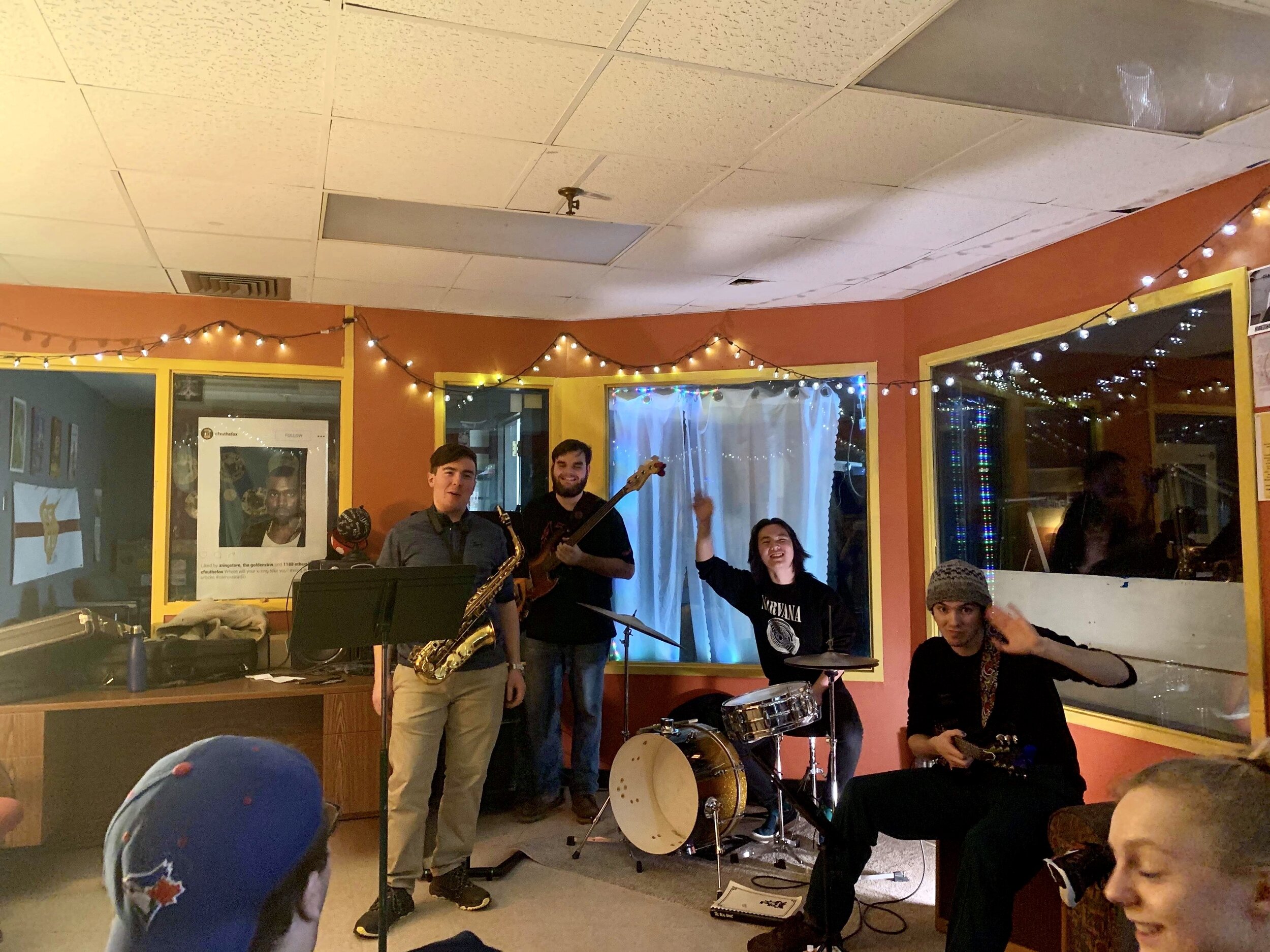
Their music, mostly coming from the Real Book of Jazz, their bible (“If it ain’t from the real book we ain’t playing it”-Robert Grier), is a nice change of pace from the Spotify DJ’D parties the night before.

Read More

‘Unapologetically BLACK’: Honouring the Black Identity

‘Unapologetically BLACK’: Honouring the Black Identity

“Unapologetically BLACK”: Honouring the Black Identity will open in the Bloomfield Art Gallery on Thursday, January 30, and run until February 29, with the opening ceremony January 30 from 6 to 8 pm.

Read More

She’s Back! Priscilla, Queen of the Highlands: “Rise of Priscilla”

AS_072.jpg

Priscilla: Queen of the Highlands is perhaps the most anticipated event on the StFX campus. The show, organized and produced by Dr. Chris Frazer (who some may also recognized as C. Leah Cruz or Joannie Cash), began in February 2005 when Frazer was appointed as 2SLGBTQ+ faculty advisor at StFX, following a number of incidents of homophobic assault on campus. Frazer, alongside Dr. Nancy Forestell and Dr. Clare Fawcett, was applying for a grant to facilitate a workshop centred around 2SLGBTQ+ experiences in rural areas, and needed to include an event. The group decided on a drag show, contacted the Imperial and Sovereign Court of Nova Scotia (similar to a rotary club for drag queens, Frazer explains), and put on a sold-out show in the KMC conference rooms.

This first show, Frazer claims, was “completely amateur,” relying on a Discman and a single set of speakers for music. However, over the past 15 years, the show has grown tremendously—transforming into a full production with professional light and sound, and moving from one conference room to two, and then to the bigger stage in the Bloomfield Centre MacKay room. Since the first show, Priscilla has raised thousands of dollars for X-Pride and other 2SLGBTQ+ focused organizations. “It’s always been a way of raising money and helping to create community,” shares Frazer. The show has played a big part in creating queer space in Antigonish, which Frazer says there “just isn’t much of.”

The show means a lot to a lot of people, including the performers. Jason Spurell, who performs as Rouge Fatale and has been part of Priscilla since the very beginning, shares that the audience at Priscilla is one of their favourites of all time. “The response, the happiness, the pride they have. Not a lot outweigh it.” In general, they note that rural crowds are most often more excited than urban ones, given that drag shows tend to decrease in frequency the further you get from a city-centre. One of Spurell’s favourite moments from the show was inviting their cousin (who used to attend StFX), up on stage— “I would bring her up on stage with me and get the whole audience to call her by her childhood nickname. She hate/loved it!”

Frazer says that Spurell’s sentiment is echoed by a number of other queens as well: “It’s their favourite show.” In fact, legend has it that Priscilla always coincides with the night that Antigonish gets its biggest storm or blizzard of the year—but the queens, and the audience, never seem bothered by the harsh weather. “There have been times where we were probably the only thing open in Antigonish—which we shouldn’t have been—and the queens had no business driving down from Halifax, but they did anyway. It says a lot about the show.”

Photos by Adelaide Strickland

While the show has only grown more and more successful, they’ve also run into difficulties financially. Tickets always sell out, yet the rising costs of space and security over the years have driven ticket prices up. Last year, for the first time, the show didn’t break even. “We’re not a money making venture, but it feels like we’re being forced to move that way,” says Frazer. “I’m really resisting that, because that’s not the point of the show … It has to be accessible, financially and physically.” Despite struggle, however, support from the community is keeping things going. Frazer recognized Impact Sound as a key supporter; the company has consistently provided a discount for their services, given the charitable nature of the show. The audience, of course, also plays a big role in the show’s continued success.

There are a number of ways that students and community members can get involved with and support the show. Ticket sales, according to Frazer, are always a good time— “it’s really rewarding to see the enthusiasm for that show build up as the tickets start to sell.” Proceeds from ticket sales and donations made at the show this year will be directed to Rainbow Railroad, an organization helping 2SLGBTQ+ refugees escape persecution and violence. Organizers are looking for support selling tickets in advance and at the door, as well as with the set-up and break-down of the production. Frazer also encourages people to think about performing— “it’s always been a part of our tradition that we encourage people to get on the stage” —in drag, or out of drag. The show welcomes Kings, Queens, genderfuck performers, burlesque performers, and pretty much anyone looking for a moment in the spotlight. Of course, for those who may not be all that keen on getting on stage, one of the best ways to support the show is to buy a ticket, and show up. “Just come, be yourself, and be fabulous,” says Frazer.

This year, Priscilla will be held on January 31st in the MacKay room. Tickets will be on sale starting January 22 at the X-Pride table in the Bloomfield lobby, and will cost $12 in advance, $15 at the door. Anyone looking to get involved in the show should contact Chris Frazer either in person or via email at cfrazer@stfx.ca.

Priscilla is part of X-Pride’s Pride Month at StFX. Other events include Amateur Drag Night, a sex-ed workshop by Venus Envy, a queer music night at the Inn, Sex Toy Bingo, and Rainbow Party. Details for these events can be found on Instagram @xpridesociety or on facebook in the X-Pride 2019-20 group.