Sweet Sweet Silver for Cross Country Teams
/
Men and Women race to second place finishes in AUS, sending five total athletes to the National Championships on November 12th.
Read MoreStFX's official source for student news since 1895
Men and Women race to second place finishes in AUS, sending five total athletes to the National Championships on November 12th.
Read MoreWhat to do when party darts become a coping mechanism.
Read MoreAnnual Student run conference provides individuals with immense networking opportunities within the sports community
Read MoreA certain amount of evidence should be needed before you can call someone a racist. If you call someone a racist, and there is public consensus, then that person will likely be shunned or excommunicated. They could lose their job and credibility and so on. So, if labelling someone as a racist has real consequences, then it is important to know what the word means before it is used willy-nilly.
It could be a statement, joke, piece of artwork, policy, controversy, costume, etc. If it has any relation to race at all, there’s a chance for racist allegations. For example: you see a political cartoon and there are different races portrayed in it. Would it be racist to exaggerate the brightness or darkness of a character’s skin? If yes, then how many shades of exaggeration are necessary to qualify as racism? By this logic, it could be considered a form of racism when models on magazines have the shade of their skin electronically augmented. Models of every race have this done regularly and willfully.
Say in this hypothetical political cartoon that the artist emphasizes features of the characters that could be associated with stereotypes of the race in question. If, for example, he draws a character with big lips when the person actually has big lips in real life, were his intentions racist? He or she may in fairness draw other characters with big ears or big noses who actually have those features in real life as well. Is it then up to us to decide which enlargements are racist because of which stereotypical association the artist may or may not have been trying to portray? It could simply be the artist’s style of drawing caricatures, or it could be that they are a racist and meant to emphasize the stereotypes. How are you supposed to know? Artistic intention may be too difficult to pinpoint, especially when looking for racist motivation.
Now to the issue of Halloween, what defines a costume as racist? Most costumes in question usually represent a stereotype of a country or culture, not a race. There is no outfit that could be equated to an entire race. Clothes are about culture. Therefore, a racially motivated costume would be something like “black face” or “white face”. It is impossible to see 1920’s “black face” as anything but blatantly racist. Even then, though, when you see black celebrities such as Dwayne Wade and Nick Cannon put on “white face” for Halloween and receive no criticism for it, questions begin to arise; are they both racist? Are neither of them racist? This double standard of acceptance makes it difficult to get to the truth of the matter.
As far as “cultural appropriation” goes, although as I said earlier it is not really about race, it is still relevant enough that it should be clarified. If all cultures can be “appropriated”, which should be the standard, then it would be fair to say that wearing a Moroccan outfit as a costume would be the same as wearing a Scottish outfit as a costume. It would also be fair to say that a Scottish person wearing this Moroccan outfit would be the same as a Moroccan person wearing a Scottish outfit. Any kind of person (Mexican, Persian, Russian, Zimbabwean, etc.) can wear these outfits as costumes and be equally offensive in doing so. No person is inherently more offensive or less offensive than another. The appropriation of one culture is not inherently more offensive or less offensive than the appropriation of another. So then the issue comes down to how the costume is presented. Is it in good taste or bad taste? Who gets to judge this “taste”? How are they supposed to know the intentions of the costume-wearer? So on and so forth until we’re back full circle to agnosticism.
Be careful and sure before you label anyone or anything as racist. It is a powerful word. Every time you criticize somebody, you are acting as their judge and jury. Do some serious thinking about labels. No one wants to be labelled incorrectly, and although the person may be ignorant, they are not necessarily racist. In turn, to avoid being called racist, it may be a good idea to steer clear when possible of statements or otherwise that may be misconstrued.
March 9, 2021, Queer students entering Bloomfield Centre were met with a common but unexpected sight. Canadian Blood Services (CBS), who due to the Health Canada restrictions on donations from men who have sex with men (MSM) enforce what many describe as a discriminatory ban on blood donations from Queer men, had set up a donation clinic in the MacKay room.
Is your acquisition of knowledge affected by gender constructs?
Read MoreWhat being an emotionally flexible university student means and why it’s important.
Read MoreReview of the Netflix original Big Mouth.
Read MoreThe media’s favourite millennial comedian, Dan Nainan, is 55 years old. He pretends to be 35 to get gigs from gullible corporate event planners, who are then punished for their foolishness by being forced to listen to his dreadful routines. Anyone with two brain cells to rub together could figure out that their favourite “millennial expert” is a pathetic fraud, which makes it pretty funny that the rich and well-educated take him seriously. He is funny though, in a bizarrely millennial way. Plenty of commentators have expunged enough hot air to account for global warming on the moral character of the new generation – for example, our inability to pull our socks up and get a damn job. One increasingly common realm of commentary, however, is more interesting. Millennials, people note, are bizarrely attracted to irony, meta-humour, and all kinds of painfully self-aware comedy.
Simply put, it’s the only sane response to a senseless system with no exit. Since the fall of the Soviet Union, only one big idea has been allowed within mainstream Western discourse. This doctrine, according to noted American political philosopher, Francis Fukuyama, states that “liberal democracy” – defined as individualism, democratic politics and free-market economics – is the “end of history”. Big things can still happen, but there is no space anymore for alternative ideas or political systems. This system, as the mainstream consensus contends, is supposedly the ideal state of society. Dissent against it is dismissed as backwards and naïve.
The whole system and every aspect of it has been monopolized by an elite which matches its cruelty only with its ignorance. We are at their mercy. The values we grew up with are corrupted and decayed. Given that it takes only a basic iota of common sense to see that things are messed up and the responsible people take themselves too seriously, what else is there to do besides resort to absurdism, avant-garde, and deeply bitter jokes that are as painful as they are entertaining?
One key pillar of Fukuyama’s vision was the free market. Letting corporations run wild controlling things that once were in the public sphere would ensure that the most competent and visionary people would run the economy. With hard work and big dreams, anyone could allegedly reach success. Of course, statistics counter-argue that our generation is the first in modern history to be economically worse-off than our parents. One need look only to unemployment rates, precarious work and uberization. Take a closer look at the people in charge. Two categories take attention: the investor class and the entrepreneurs. Investors essentially run the economy. With the rise of “index funds”, among most parts of the economy that actually make things – cars, for example, or missiles – almost 90% have shareholders in common. In other words, the same group of investors have control over a range of companies that should be competing.
In the late 90s, investors speculated wildly on Asian financial markets and debt before realizing that none of their money was tied into any real value. They panicked, fled the market and plunged the whole Pacific region into chaos. In the early 2000s, they turned to website names. Hundreds of millions of dollars were paid for sites like pets.com. Upon realizing that website names had no actual value, they again fled the market and wiped out $5 trillion and countless jobs. In 2008, they once again overheated the market on mortgage bundles, once again spent too much money on things that don’t exist or create value and accidentally ignited the biggest recession since the 30s. They did the exact same thing three times within two decades and expected different results. Now they’re at it again with technology, home to the new heroic class of entrepreneurs.
People like Mark Zuckerberg, Elon Musk, and Jeff Bezos of Amazon are made heroes. Yet close inspection reveals otherwise. Zuckerberg’s latest big idea is to become President and he’s on tour trying to convince the people that his practice of selling personal information is good. Elon Musk is closely associated with Silicon Valley creep Peter Thiel, who wants to replace democracy with techno-feudalism. Furthermore, Musk plans to set up his own personal Mars colony of which he can be the feudal overlord. Jeff Bezos provoked a grotesque urban bidding-war for the new Amazon HQ where elected officials debase themselves for his entertainment. He’s also notable for crushing unions, consolidating media power and building a poorly-paid reserve army of old people living in RVs since the housing crisis took their homes.
The economic ruling class hence checks off two boxes – evil and stupid. Tech doesn’t produce much intrinsic value and bankers only seem to create value that they reliably destroy within a decade. Peak economics was the decision by a series of well-respected investors to put $120 million into the Juicero, a juice-squeezing machine with wifi connections where the specialized juice packages could easily be squeezed by hand. It sold for $750. The whole affair is a perfect symbol of modernity and it’s hilarity.
The political class is, if possible, worse. Donald Trump, as the Business President, is a perfect example of the corporate ethos at work. He’s gauche, stupid and enriches himself through misery and failure. He’s treated as a political abnormality, deviating from democracy’s perfect promise. As it turns out, though, Trump is standard. The most powerful in society are just as short-sighted and profit-motivated as him. The ideas he champions – mass privatization, tax cuts and white resentment – were equally used by George Bush and Bill Clinton. Heck, in 2008 Hillary Clinton adopted a Trumpian rhetoric by saying her presidential campaign was for “working, hard-working Americans, white Americans”. Until society is radically restructured for the better, the “free world” will be at the mercy of race-baiting anti-poor hacks.
Now for the great champions of anti-Trumpian democracy and liberty. Are they kinder or just smarter than their supposed great enemy? Justin Trudeau, for example, has centralized cabinet authority in the same way as Harper. He’s performatively woke, but still ships tanks to the Saudis, used to run over protestors, and he squirms his way out of denouncing Quebecois Islamophobes. Another one of Trump’s supposed great challengers, Angela Merkel, recently launched an impassioned defence of gay marriage bans and social service cuts. President Macron of France, a centrist ex-banker, has enacted an economic agenda of lower taxes for the wealthy, less programs for the needy poor and attacks on unions of a scale that Trump could only dream of. He also loves entrepreneurs, because apparently even France needs hackable juice machines.
The world these people constructed should not be seen as normal and anyone with a remote concept of moral conviction should be able to see this. Unfortunately, we’re officially living in the end of history and conditioned to see bad things as good. We’re stuck on the fast train to climate disaster and financial collapse, and this train is operated by sadists. The way we cope is to turn to humour. What kind of humour fits our reality better than irony and self-deprecation?
The classic jokes with a clever punchline operating on a twist just don’t work anymore. The twist can’t be as unexpected as what world leaders may shortly tweet. For something to be properly funny in the modern era, it has to be self-aware. As an exemplar, everyone knows the internet anime Nazis exist. Their reality is funnier than any joke you could tell about them. Noted Twitter troll Virgil Texas provoked their boundless fury by starting a Wikipedia editing war over Garfield the Cat’s canonical gender. The original cartoonist had to be called to end debate, by which point the right-wing rage had reached anonymous edits from the US Congress. It’s funny because it is as absurd as the real world. Jokes about the economy being bad are old hat. Joking about our personal looming futures as unemployed and miserable in a cyberpunk hellhole gets mileage because it plays off of how sad-sack things actually are. We appreciate a grim and realist edge.
We arrive at millennial comedy. The world is garbage. There is, for now, no path out. The only coping mechanism is to retreat into the kind of absurdity that both mocks the current order and – whether it comes through elaborate pranks, self-satire or the daftness of everyone involved – has an active real-world component. If comedy is art, then it’s been ages since art has gotten this weird. The last time people got this inventive was the 1930s, when playwrights like Berthold Brecht created bizarre multi-level performances that partially involved the audience and reflected the chaos of the outside world. The 1930s, a similar time of crisis and despair, had well-known consequences. Our only consolation is the old saying that “all great events happen twice: first as tragedy, then as farce”. Our leaders are too petty and foolish to end the world, except possibly in a Three Stooges-style slapstick accident. We live in Stupid Thirties. Let’s enjoy ourselves.
March 9, 2021, Queer students entering Bloomfield Centre were met with a common but unexpected sight. Canadian Blood Services (CBS), who due to the Health Canada restrictions on donations from men who have sex with men (MSM) enforce what many describe as a discriminatory ban on blood donations from Queer men, had set up a donation clinic in the MacKay room.
StFX's new financial news publication that is taking the large major pieces of information that are happening within the Canadian market and boiling it down to a fairly simple and impactful resource.
Read MoreWellspring is StFX's hidden gem.
Read MoreAn interview with Nate Leipciger, a Holocaust survivor.
Read MoreLiving Learning Communities and the future of residence at StFX.
Read MoreDalhousie Student Union rep sparks a debate over who to protect when it comes to free speech
Read MoreFinding balance in your body, mind and soul.
Read MoreWhat does remembrance day mean to Canadians.
Read MoreMarshall Gilkes, Five Dollar Combo, Truro’s Cobequid Educational Center, and other artists performed at StFX.
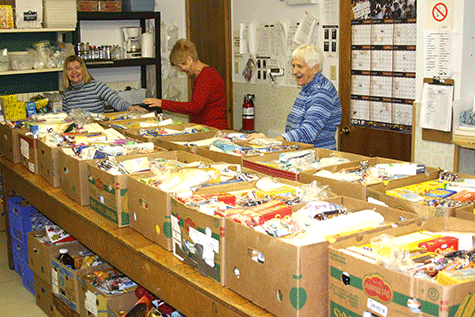
Read MoreA look into food security and our town’s resources
Read MoreTheatre Antigonish has spent the past few months preparing their new dramatic spectacle, Cerulean Blue. The play is written by Drew Hayden Taylor and directed by Andrea Boyd.
Read MoreBringing in the Bystander and why it's crucial to have it on campus.
Read MoreA new law passed in Ontario bans protesting near abortion clinics.
Read More