StFX for SAFE to hold Peace for Syria Walk
/
Let's walk together to promote Peace for Syria
Read MoreStFX's official source for student news since 1895
Let's walk together to promote Peace for Syria
Read MoreLocal business strive to end the negative stigma around breastfeeding
Read More"You have the right to #peeinpeace."
Read MoreWhy political correctness is failing us
Read MoreThe prevalence of ADD, ADHD, and prescription drugs at X
Read MoreThe pros and cons of studying abroad
Read MoreWe asked ten fourth-year students where they're getting their X-Rings. Here's what they said.
Read MoreStanding in solidarity with sexual assault survivors
Read MoreAn examination of changes to life 'round here
Read More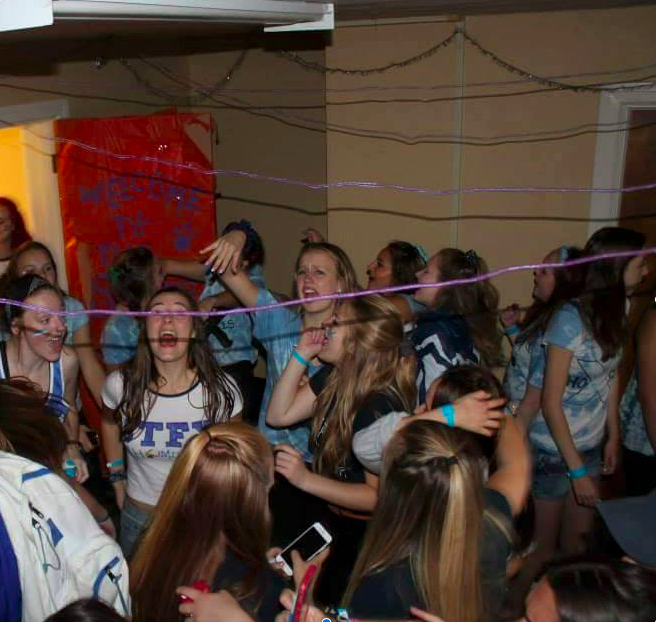
residents get rowdy at Homecoming 2015 - photo: mikaela Jahrig
Homecoming is a weekend celebrated by many. Over a thousand StFX graduates return to campus every year, to catch up with old friends and see the changes that both the university and Antigonish have gone through since they received their X-Rings and walked the campus as undergrads. Current students see the weekend as a reason for celebration, and there are parties and community events back to back for the entirety of the three days. Saturday brings the crowd to the StFX field where, this year, the X-Men will kick off against the Saint Mary’s Huskies at 2pm for one of the biggest games of the season. Students come dressed in blue and white, with signs and face paint ready for a day hyped up with school spirit.
For many years, current students living in residence had the opportunity to sign in friends coming from different universities to join in the celebrations. The minute the sign-up opened, Resident Assistants (RA’s) and House Directors (HD’s) were bombarded with residents attempting to get their friends name on the coveted list. Once the weekend rolled around, bracelets were handed out and only those with the right coloured bracelet would be allowed into the corresponding residence. However, this year, the university has decided that guests are no longer welcome for Homecoming.
Bob Hale, Head of Student Services, states, “We have historically had a lot of damage by guests in the residences and we are trying to minimize it this year. There are lots of events to celebrate Homecoming, so honestly, I do not believe it will take away from the celebrations." Just last year, Homecoming resulted in thousands of dollars of damages in most residences, with broken ceiling tiles, holes punched in walls, and overall disregard for school property. Therefore, it seems logical that the university decided to ban guests completely, although students are certainly not happy with the decision.
Applications for Residence Assistants (RAs) were open much longer than normal last year, and Residence Life seemed desperate to get enough students willing to step up and man the halls of residences. This year, staff is extremely tight and many are working more than they had expected to be. Homecoming, especially when guests are welcome, is a stressful time for Res Life staff as RAs are posted at every doorway checking bracelets in each and every residence, not to mention dealing with conflict brought on by drunk, excitable students. RAs were reluctant to work in some residences, subsequently leaving them short staffed. Therefore, the decision to ban students from other universities appears to have also been brought on by the lack of staff to control situations that may arise.
Although many current students have expressed resentment towards the no guest policy, Homecoming is certainly a weekend catered to the returning alumnus, with campus tours, a Welcome Home dinner, and the President’s Reception and Golden Grad Dinner - this year honoring the Class of 1966 on the fifty-year anniversary of their graduation. Students and the university are still optimistic that Homecoming will go smoothly, provided weather is cooperative.
A trigger warning is a disclaimer found at the start of a piece of writing or other media, which simply warns the audience that the following may contain potentially distressing and upsetting material for certain demographics. The reception to these warnings are mixed, with some saying it’s overkill. Here’s why they are wrong:
The University of Chicago recently published an open letter to its incoming first year class about how they do not support the concept of trigger warnings, and that they believe these types of messages hinder the academic process and perpetuate censorship. The supportive cries of the right wing can be heard ringing through the comments section of each news article reporting on this letter. “The social justice warriors are at it again” or “all these millennials just want their hands held, and can’t deal with the real world.”

photo: triggercast.wordpress.com
Trigger warnings are not censorship, and they are not a way to prevent discussion of controversial topics. They also aren’t a way to hold the hands of the ‘PC’ generation. They are literally just a way to warn people of what’s coming up next- a simple common courtesy. The issue with the trigger warning debate is the wording itself. ‘Trigger warning” has become a loaded term, used in memes and twitter mentions to refute arguments or statements made by certain people in the online community.
To really understand the concept behind a trigger warning, one must possess empathy, or the ability to put yourself in the figurative shoes of another. While it must be noted that it is impossible to put yourself in the shoes or mindset of someone who has been raped or who suffers from PTSD if you haven’t shared that experience, one can very easily determine that nobody wants to be re-traumatized over something so easily preventable. This is what triggers do: re-traumatize you. It’s relentless, it’s terrifying, and for the most part it is unpreventable. These warnings provide a buffer to individuals who may find certain content painful to watch or be exposed to.
Another dimension to this debate is that rejecting trigger warnings adds to the stigma of mental illness. It’s basically like saying, “just get over it” or “your mental illness doesn’t matter to me.” Just because it doesn’t affect you, it doesn’t mean you get to decide whether it should exist or not.
MacNeil HP and VP temporarily relocated from residence
Read MoreElizabeth Gushue and Iain MacLellan compete for Frosh Councillor position.
Read MoreThe 1970 Report of the Royal Commission on the Status of Women in Canada identified notable gender inequalities in post-secondary education systems. At that time, women made up just 38.6% of all university students. Today, however, the tides have changed – it is men that are the vast minority across undergraduate institutions nation-wide. Just as it was in 1970, this inequality is a serious issue, and one which deserves critical attention. But it just isn’t getting any.
There isn’t a fervent movement fighting for men’s rights as there was for women forty years ago, and because the education gap is an isolated issue of inequality, it tends to be lost amidst the sea of women’s rights issue which permeate the main-stream media. If do we not address the systemic issues in public education that are keeping men from universities, then the underclass of uneducated men that has formed in Canada and the United States will continue to grow.
In an age where the manufacturing sector has all but vanished, allowing such a demographic to develop is especially dangerous. I can only hope that this article will make you realize that gender equality is a two-sided coin and that it will finally begin to shed some light on the plight of young boys in the public education system.
A recent study by Statistics Canada researches, Marc Frenette and Klarka Zemen, set out to explain the gender gap in university participation. The authors noticed that, by age 15, males were lagging behind females in several observable performance metrics. Study habits and parental expectations were chief on the list. The study concluded that, if boys were to pull even with girls in these areas, the gender gap would close by almost 80%.
According to Leonard Sax, an education expert and published scholar, there are a few systemic issues in public education which, if removed, would quickly allow for improvement. Sax specifically mentions the overreliance on medication for attention deficit disorders and an unnecessarily strict emphasis on kindergarten math and reading requirements. Perhaps if, at a younger age, boys were being encouraged to learn through activity rather than being dosed with Ritalin pills, they would enjoy being at school a little more. Of course, as Sax points out, the soft sexism of low expectations is also an issue. The only way to raise parental expectations is to combat the misguided attitude that girls are naturally smarter than boys (an attitude that has grown over the last few decades).
Unfortunately, Sax’s message has been undermined by those who misrepresent the gender equality movement and assume that to be “pro-boy” is to be “anti-girl”. These people propagate the dangerous illusion that women are unequivocally oppressed and men are always the oppressors. I can only hope that, in the end, critical thought and objectivity will win out against these misguided individuals.
An examination of life as a new arrival
Read MoreThis Friday, September 16th, Central Nova MP Sean Fraser will be hosting a Town Hall session for StFX students.
Read More