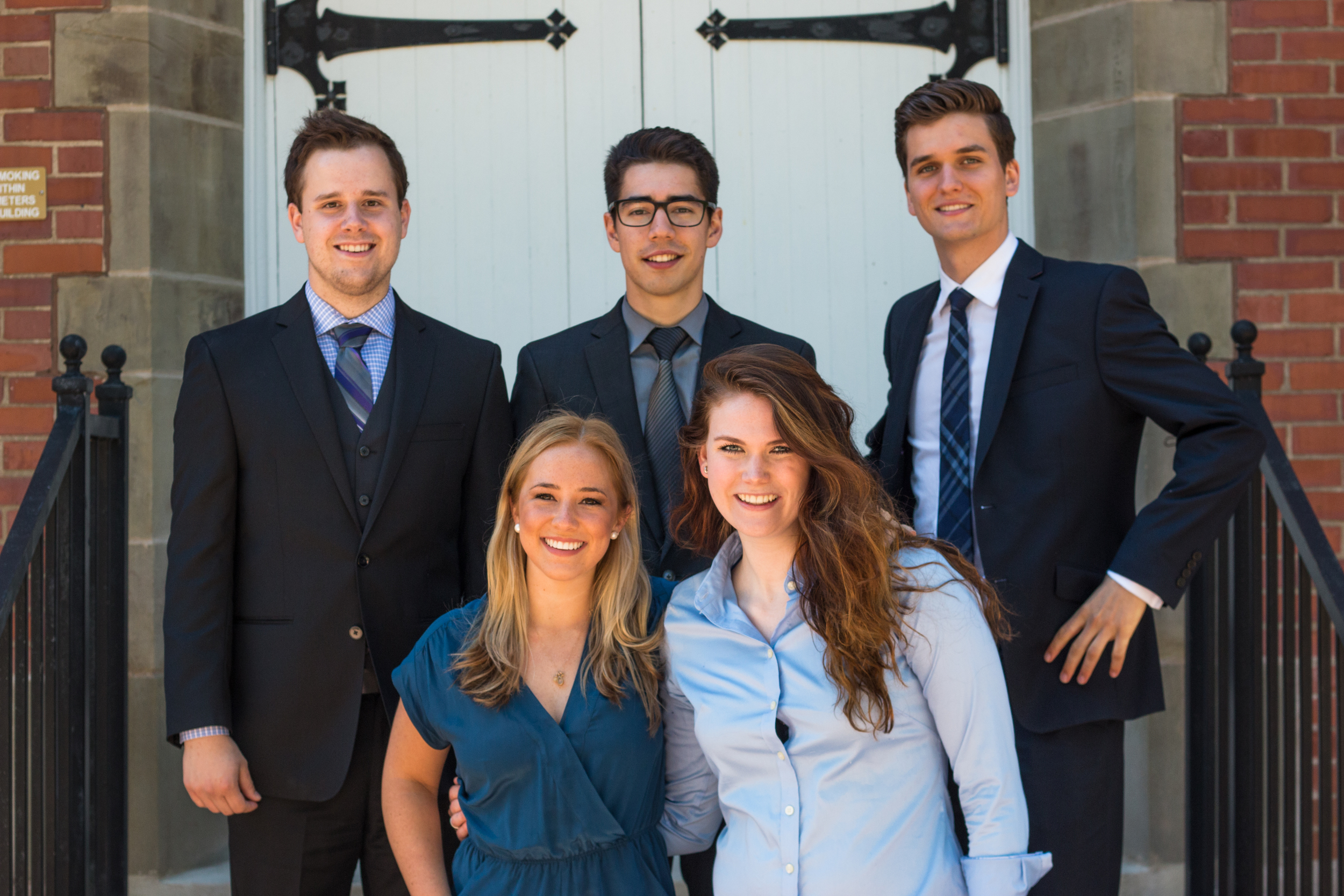
Meet your 2016-17 Councillors
/
Getting to know this year's elected representatives sitting on the Students' Union Council.
Read MoreStFX's official source for student news since 1895
Getting to know this year's elected representatives sitting on the Students' Union Council.
Read MoreMacPherson House now occupying bottom two floors of MacDonald.
Read MoreAll Net Profits to go to the StFX Xaverian Fund for Scholarships and Bursaries for Students
Read MoreLessons we should all probably know
Read MoreAs most of you have probably heard, Maclean’s magazine recently rated StFX as the “#1 Party School in Canada”.
I picked up the last issue of the Xavarian Weekly hoping to get some varied, clear, and concise thoughts and opinions on our newly achieved honour. Instead, there was only one piece that denied the accuracy of the survey, then conceded to it, accused the faculty of conspiracy and the school as having “a problem”, debated StFX’s image without giving much of an opinion, and finally called for an academic revolution within the liberal arts faculty to regain its prominence over “practical degrees” such as business and nursing.
I hope I wasn’t the only one left scratching my head at this.
I appreciate the attempt to resurrect the extinguished glory days of StFX liberal arts program (I’m an arts student myself), but it is simply wishful thinking. StFX will never be what it was, nor will any other university. The author does admit it is a product of “the flow of the times”, and he is absolutely correct. The university scene is evolving. People want more than an education from post-secondary institutions. There is a cry for an all-encompassing experience as well as the guarantee of job certainty in today’s turbulent employment market. You can’t blame StFX for changing with the times, and if you don’t like it you can go “invest” yourself in a different university.
Obviously, I think there were a few issues left unaddressed by the latest article, and wish to clarify, inform, and give you my opinion on what it means to be the “#1 Party School in Canada”.
Under normal circumstances, national recognition of any type would be warmly welcomed by the student body, faculty, and staff with humility and pride, but this news seems to elicit a mixed reaction from the Xaverian community.
There are people who deny it. They ardently swear StFX isn’t any worse than any other university and that our academics mean more to us than you’d think.
There are those who love it. They will tell you StFX has way more and way better parties than any other school across the country, which is probably true.
There are those who will tell you, yes, partying is part of StFX, but it’s not all of StFX. Look at our sports teams and our academics. We are so much more than just a party school. This is the message sent by Kent Macdonald in the “We are StFX” video posted to Youtube two weeks after being nominated top party school.
There are alumni who hate to see their alma mater be slapped with such a title, and there are other alumni who concede to it without much argument. As the author of the previous article mentioned, “Came for the party, stayed for the ring” is not a new expression.
In my opinion, all these reactions boil down to the same thing: people trying to control StFX’s image. But if there’s anything I’ve learned, there are some things that are out of your control. Yes, we are the top party school. But I don’t think we should flout it, flaunt it, or attempt to assimilate it with the rest of our identity any more than anything else.
Ultimately, this news in no way changes my experience at StFX.
Some say, but what about my academic/professional future? How will this “party image” affect the value of my degree? My response to those people is that you were the one to decide to come to StFX. This isn’t the first time we’ve been ranked amongst the best party schools by Maclean’s, so unless you’ve been living under a rock for the past fifteen years, you can’t deny knowing what you’ve gotten yourself into.
In the end, you came to StFX for a reason. Whether you came for the all-encompassing experience and a practical degree or for the pursuit of higher learning and top-notch professors, you will have the chance to experience all of these things before graduating. And that’s what I think the most valuable part of the StFX experience is - it’s having the choice to be a part of all these things that make StFX great.
An Opinion About Why Sports Matter
Read MoreA Love Story Told Through Music
Read MoreCreativity Died
Read MoreA critical debate of the U.S. Democratic Candidates
Read MoreA look at the incoming executive.
Read MoreThe Golden X Inn now offers lunch on Fridays.
Read MoreLauren Agnew
Most athletes will tell you that they are willing to sacrifice anything for their sport; they put their bodies and minds on the line every day either for glory, sheer love of sport, or both. But what about when disaster strikes? What about when the sport you love causes you to sit on the sidelines? For X-Women Rugby Fullback Breanna Allison, this is exactly what happened.
Allison, whose friends and teammates call her “Bre”, has been a starter for StFX since her first year in 2013. Now in her third year, Bre has been sidelined with an injury expected to keep her off the field for at least a year. In a game against the UPEI Panthers early in the 2015 season, Bre was playing her usual position of fullback at number 15 on the field. It was a perfect day for rugby, with a few clouds and no wind, and the X-Women were set to win their first game of the season. Unfortunately, a few minutes into the second half Bre was forced to make a try-saving tackle. While it was spectacular to watch from the sidelines (Bre absolutely flattened the opposing player), on the field it was a different story: “I knew something was wrong right away, “says Allison, “But to be honest I didn’t think it was too serious. It just looked swollen right away, so I assumed that when the swelling went down I would be back on the field”.
The injury would prove to be a fully torn right ACL, an injury that is becoming increasingly common in female athletes. Bre says she was surprised when she got the results of her MRI back, saying “I didn’t hear the snap or the pop or anything they say happens when you tear your ACL. I really didn’t think it was serious”. After a three month wait to see a surgeon, the tear was finally repaired. Then came rehab. For another three months Allison was limited to using crutches to get around the icy StFX campus, an unfortunate impediment given the timing of the injury.
Allison says she is excited to get back on the field, but also “incredibly nervous.” She explains “I feel like I’m starting at ground zero. Now that I can slowly start training again I am so far behind my other teammates. I only just got cleared to run again.” Bre adds however that this has become her main source of motivation: “I want to get back on that field and back in a jersey” and she says she will to anything it takes to get there.
The X-Women broke a 17-year championship winning streak this year, losing the AUS title at home to Acadia. Allison says that she is “anxious to get back and help [her] teammates take back the title.” But the effects of the injury are more than physical, there is a mental side as well. Bre worries that her injury will make her hesitate more on the field: “Once I get past the first tackle it will be fine. But that first one will be tough. I need to know my body can handle it again. As soon as that first tackle is over I know I will be more than ready, it’s just more motivation to get back.”
Recovery can be frustrating, but Bre is thankful that she has her teammates for motivation and support, and adds that she is doing everything in her power to get back to training camp in August, and on the field for her fourth, and maybe even final year of rugby as an X-Woman. At the end of the day, having a positive attitude about the process and the prospect of returning to play is what keeps Bre working hard. “I still don’t know if I’m coming back for a fifth year,” she says, “but I do know that I’m not done yet. We have another championship to win.”
Social activism blooming in the world of professional sports
Read More
I remember calling my boyfriend to tell him I had been raped. We had only been dating for two and a half months, most of which was long distance. Of course, it was uncomfortable - only a month before that phone call he had been visiting me, and suddenly I’m calling him to tell him I was raped by a friend of mine. We had just really started getting to know one another and then I was not the same person. There were so many changes during that time, and approaching sex was one of them. When talking about sexual assault, it seems sex after assault is not addressed or merely glossed over.
Recently I saw a post on YikYak where the posters were saying they did not know how to be sexual, or have sex at all since they were assaulted. This makes sense. Whether you are in a relationship or caught up a one-night thing, sex is intimate. When this trust you’ve put into someone is betrayed, in such an intimate act, it can be hard to regain that trust and your sexuality. Each person will recover in their own way, and in their own time, but I would like to share with you some things that helped me regain control over my sexuality, and hopefully help you find your own. This has not been quick, nor had it been easy, but it is important. You can be a survivor of sexual violence and be a sexual person.
Sexuality is not only about the act of sex - it’s also about feeling confident in your body again. There is a lot of self-blame that follows sexual violence, and questions about whether or not you could have prevented it from happening. I spent a lot of time being self-conscious of my body and how it would be perceived by those around me. I wanted to feel sexy and confident but I was afraid to do so. Would it make me less of a survivor to wear sheer tops and short skirts? Could I ever safely feel sexy again?
One night I went out to see a friend of mine DJing, and my friends and I were all really excited. But this all changed when the student who raped me was there, and spent the entire night following me around. I was dancing with my girlfriends when I felt arms around my waist and lips on my neck. He was standing behind me, touching me, and so I froze. I looked desperately at my friend who started yelling at him to leave me alone. He did not try and talk to me or touch me after that, but he continued to follow me wherever I went.
It’s scary, haunting, frustrating and invasive, but here’s the thing - sexual violence is never your fault. It is important to remind yourself that there was nothing you did to made it happen. So following the assault, I told myself that I would not be broken by this; I would be strong and recover and not allow my body to be controlled by him anymore. So I masturbated. Which is a weird thing to admit to an unknown number of readers, but that is how I started being sex positive again. I made my space safe and comfortable, I found my preferred entertainment, and spent some time loving myself at my own pace. When I started to feel overwhelmed, I stopped and took time to relax. If and when I felt ready, I continued.
You know your body, so listen to it. Take time to make yourself feel physically good because you deserve to feel good. The goal is for you to rediscover sex and pleasure, so do not make it a race. After experiencing sexual violence, you feel robbed of control over your own body. Masturbation is a great way to work towards regaining the power over your own sexuality. You decide what you watch, listen to, read, or imagine, and you decide your limits. Regaining control over your sexuality is very important in finding the confidence you need to enjoy sex with a partner in the future.
Now, for sex with a partner. I am going to operate on the assumption that any partner you choose will immediately respect your decisions and listen to your needs, because the best sex is the consensual kind.
First, go slow and spend a lot of time in foreplay. What better way for you and your partner to prep for sex? There is communication throughout, it feels good, and it ensures that your body is physically ready for sex. Foreplay is a good time to check in with yourself (and your partner) to make sure that you are feeling up to having sex. You and your partner have the opportunity to explore one another’s bodies, discover if there are any changes in what you do and don’t like. Take your time being sexual with your partner and learning to be comfortable while being so.
During the first few times I had sex after my assault, I felt very different. I felt like I had to be much more aware of what my boyfriend was doing and what I was feeling. Thus, is it no surprise that there was a persisting sense of anxiety. What if he got caught up in the moment? What if he didn’t stop if I needed him to? This is why I cannot stress the importance of communication enough, and to have sex only if you feel ready for it, and when you do, take it as slowly as you need.
Remember, you can stop at any point. The moment following might be uncomfortable. You may be feeling overwhelmed and pressured. Perhaps you experienced a flashback. Your partner may be feeling guilty, responsible and concerned. But these feelings are all okay. I remember when I had a flashback once in the middle of sex. I do not know what happened, but I opened my eyes and I did not see my boyfriend, I saw my rapist. I freaked out, started crying and shouting at him to get off of me (which he did immediately), and just rolled over and started sobbing. I felt embarrassed and scared, and he felt like he had done something to hurt me. This was so upsetting and awkward, but not the only time it happened.
You are not to blame, nor is your partner. Please know this. Talk about it, reassure one another and take the time you need before having sex again. Triggers and flashbacks are wildly inconvenient and unpredictable. They can happen while you are walking to Nicholson Hall and in the middle of sex. And while communication will not stop them from happening, it does help. If you and your partner communicate before and throughout sex, it can make the experience much less stressful. Communication is not necessarily, “Like this? Do you want to do this? Can I do that? Hey you all good?” While it can involve asking these reassuring questions, it is also moaning and body language cues. If your partner starts tensing up and seems unsure, check in with them. Sometimes it can be hard to express something outright, and asking will let them know you are listening. Be honest with your partner - if something feels off, tell them. This is new territory for everyone involved and everyone needs honest communication in order to have a healthy sex life.
It is difficult to move on from assault, and being on such small campus makes it even harder. While you may run into them at times, you also cannot stop living life because of this person. You deserve a full life with fun nights and amazing memories with your friends. Always make sure to bring trusted friends with you. If you start to feel uncomfortable, get somewhere that you feel safe. Life will continue regardless of whether you are hiding in your room or out with your friends. Do what will make you feel safe and happy, but do live your life to its fullest. If that means watching a romantic comedy while crying into ice cream (like I did), that is perfectly fine. If it is braving the line at the pub to get funky on the dance floor with your amazing friends (I also did this), that is perfectly fine too.
By making decisions based on what is right for you, you will find your confidence and in time reclaim your sexuality. It does not happen overnight: it takes work and patience. But when you find yourself in a place where sex is fun and pleasurable, and a night out - or in - requires less finding where the nearest exit is, and more “Holy shit I love this song,” you’ll know it has been worth it. Be sexy, sexual, and confident. Above all, be true to yourself.
If you have been a victim of sexual violence, I urge you to talk to someone. You are not alone in this, and there are people out there who will do everything they can to help you. This was not your fault. You can get through this.
We’ve got your back.
The Decline of Accountability and the Rise of Cowardice
Read More
There will soon be a new policy regarding sexual assault and sexual violence at StFX. In response to concerns about sexual assault, the university administration is proposing a new framework to define sexual assault and sexual violence and to lay out the steps that ought to be taken to respond to these cases. This new policy has been the subject of consultations with faculty and staff, and some faculty have indicated concern about the policy, including philosophy professor Christopher Byrne.
In an email circulated to all faculty, Dr. Byrne outlined his concerns with the policy. He particularly takes issue with the proposed definitions of sexual violence, which he finds far too broad. For example, part of the definition of sexual violence in the new policy reads, “Acts of sexual violence include: unwanted sexual comments or advances; coercion of another person’s sexuality by physical or psychological intimidation; and/or the denial of another person’s sexual decision-making rights.”
As Dr. Byrne writes, “The way in which the new policy defines sexual violen [...] creates a problem: sexual violence will now be defined so broadly that the type of behaviour henceforth subject to punishment will be expanded enormously, far beyond what would normally be considered to be acts of sexual violence. Some of the types of behaviour that would now count as sexual violence sound rather odd; for example, it is hard to see how sexual violence should include the denial of another person’s sexual decision-making rights (this phrase seems to suggest that we are guilty of sexual violence if we deny someone else’s request for sexual favours).”
He also questions the need for this new policy, considering that numerous policies already exist to govern the issue of sexual assault. “We already have several policies on this matter, which collectively govern the conduct of all StFX students, faculty, and staff. Why, then, do we need yet another policy on sexual assault? Why don’t we just enforce the many policies that we already have?”
Dr. Byrne claims that there are issues with clarity in the policy, which makes it challenging to figure out what exactly constitutes sexual assault under these new rules. “In part, the new definition of sexual assault is rather obscure; violating someone else’s ‘sexual integrity’ is henceforth to be considered sexual assault, but no light is shed on just what ‘sexual integrity’ is. Most important, among the many types of behaviour that will now count as sexual assault is exercising ‘control’ in such a way as to make someone else feel uncomfortable. In other words, doing anything that would make someone else uncomfortable is now to be considered an act of sexual assault and, therefore, sexual violence.”
In a interview with the Xaverian, Dr. Byrne expanded on this point. This new definition of sexual assault is significantly broader than the criminal code definition. According to the professor, this is a concern for students because of “the notion that if you leave StFX with a conviction of sexual assault, people are going to think of the criminal code definition of sexual assault.”
Dr. Byrne explains that the StFX administration recently informed the faculty that these new rules will only apply to students. “This is more of an issue for students; if what we were told on Wednesday [during consultations with staff] is correct, it won’t apply to faculty and staff.”
The Xaverian also reached out to Women’s and Gender studies professor Rachel Hurst to hear her point of view. She is a member of the committee that helped design the new policy on sexual assault, and she addressed several potential criticisms of the new policy via email. In the email, Dr. Hurst explains what motivated her to seek a new sexual assault policy.
“Please note that I am not speaking on behalf of the committee, or even as a member of the committee, but rather as a concerned faculty member to whom students disclose sexual assaults, and have done so each year since I came in 2009. They have done this not only because they trust me, but because there has been a shameful lack of information and clear direction available to them on their options [after a sexual assault]. The primary purpose of the policy is to provide a resource and clear framework that spells out options for the students, who have been underserved for so long.”
Hurst defends the new definition of sexual violence, writing, “Regarding the argument that the definition of ‘sexual violence’ is too broad/vague: In constructing this policy, we have sought out national and international research and best policy practices related to sexualized violence prevention and definitions and approaches to disclosure, reporting, and community education. All of the definitions we have used and policy conclusions we have reached are drawn from policies that have been enacted at other progressive universities in North America, and in consultation with relevant policies at StFX (notably, the Community Code and the Discrimination and Harassment Policy). Part of the challenge, of course, is that in general it is difficult for some to recognize emotional and psychological violence as ‘real’.”
A thespian’s tale of theatre in today’s world. Rob Halligan
Read More