Another year, another dominant StFX hockey team


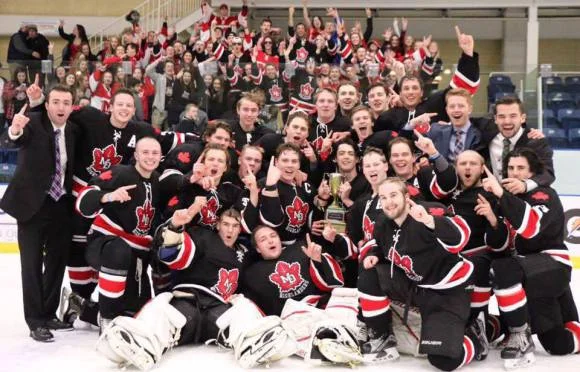
As the AUS regular season winds down in ice hockey, there is a familiar site at the top of the standings. StFX is off to another rollicking season as they have garnered a 19-1-4 record on the year, good for second in the AUS, behind University of New Brunswick. 

Jagger Dirk is the key cog on the Defense, with 22 points on the year for the senior from Penticton, BC. Dirk was a former player for the Kootenay Ice of the Western Hockey League. He had a very successful five-year career with them, contributing 48 points in his final year with the junior club. In his fourth year with StFX, Dirk has solidified himself as the number one Defenseman in the AUS, as he has already surpassed last year’s point total by nine. 

The three-headed monster of Holden Cook, Matt Needham and Michael Clarke have provided timely scoring, contributing eight game winning goals on the year. 

Oshawa born Cook is the leading the team in points, with 29. Prior to StFX, Cook was a shut-down forward for the Owen Sound Attack of the Ontario Hockey League. His point scoring was modest at best in the OHL, but StFX has provided a unique opportunity for him to flourish. 

Ontario-born Clarke, along with Needham, are tied for second on the team with 27 points. 

Leading the way in goal has been second year Halifax native Chase Marchand. He is leading the league in both save percentage (.931) and goals against average (2.10). 

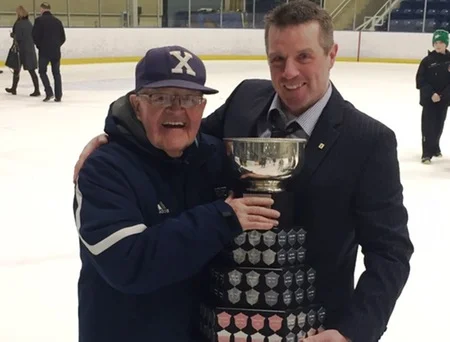
The X-Men is led by head coach Brad Peddle. He is in his 13th year at the helm of StFX. He previously played for StFX as a student from 1995-1999. Through his guidance, the team has rattled off 12 consecutive AUS playoff appearances, including five University Cup championship appearances. He is still looking for an elusive national championship, which would be the first since 2004, coached under Danny Flynn. 

Peddle stressed the importance of garnering character players for the team. “We really try to recruit guys who will buy in to what StFX is about and will fit into the culture that we have created. Great People, great students and great hockey players.” 

StFX is locked in a two-horse battle for first in AUS this year with UNB. The squads have split the season series so far at two-a-piece. StFX has bested UNB in the past two AUS finals, however it was UNB who defeated StFX in the 2016 National Championship, which took place in Halifax. They are also victors from the year after, defeating the University of Saskatchewan. StFX is hungry for another crack at the defending champions, should they play in the playoffs. Luckily, the team is laden with good, experienced character players, with many of them having played in that heartbreaking final in 2016. 

“X and UNB seemed to have played against each other for as long as I remember in the playoffs. And at the end of the day, it is just two good hockey programs bringing out the best in one another.”

Coach Peddle had the opportunity to coach the U Sports All Star team in December, as they played two games against the Canadian World Junior team. The team defeated Team Canada in back to back matches. Holden Cook, Jagger Dirk and Michael Clarke were all selected for the team. 

On the experience, Peddle commented: “Players didn’t know each other very well so we had to try to bring them together quickly. This year we did some team building activities in hope that it paid off, and it did!” He was an assistant coach with the team the previous year. 

With six games left on the year, the team looks to garner a number one spot in the AUS Playoffs. The final two home games are against Dalhousie and Moncton on the 2nd and 3rd of February.
 

Indigenous symbols in professional sport, insult or honor?


Throughout professional sports, a wide-ranging usage of indigenous symbols has come to the forefront of moral and societal values. Teams that still use Native American imagery include: Atlanta Braves, Washington Redskins, Kansas City Chiefs, Cleveland Indians, Chicago Blackhawks and countless high schools and colleges. One can not ignore the brazen mistreatment of indigenous individuals throughout North American history so the question persists: Is it honor and positive recognition, or insult and degradation for these logos to still be used today?

The term ‘Redskin’ has been referred to as a derogatory term for Native Americans in the United States. Nowadays, the word is scarcely utilized in day-to-day lingo. Unfortunately, public backlash and political pressures to change the name have been highly refuted by the team owner Dan Snyder. He was quoted in 2013 as saying: “We’ll never change the name. It’s that simple. NEVER- you can use caps.” The perverseness of how referring to a professional sports team as a “Red-Skin” still exists in 2017 is mind blowing. Yet, only real change can occur from the top, and without an ownership change, the name will more than likely stick around.

The Cleveland Indians have a convoluted and complicated history surrounding their name. Indians was formulated in 1915, after going through several other names such as Naps, Blues and Spiders. Their primary logo (until recently) is of Chief Wahoo. Chief wahoo is a cartoon caricature of a stereotypical American Indian face. In 2014, team owner Paul Dolan indicated that the team would use a block C as their primary logo, yet the Wahoo symbol is still emblazoned on side of jerseys and some home caps. “We are people, not mascots, not logos, not imagery, Chief Wahoo does not represent anybody that I know or anybody in my tribe or family” says Potawatomi Tribe member Carla Getz.

The Chicago Blackhawks were one of the founding ‘Original Six’ teams of the NHL. They were named after an infantry battalion in World War I that paid homage to the great warrior ‘Black Hawk’, who was a prominent figure for the state of Illinois. The name and logo have been scarcely modified, with ‘Black Hawks’ changing to Blackhawks in the 1980s. For locals and fans, the name represents an umbrella of shared ideals. It represents a history of athletic achievement and hardships with thousands of players and fans throughout more than half a century. The name does not represent Native American’s stereotyped history.

The Kansas City Chiefs arguably have the tamest idealization of indigenous symbols. Their logo has been an arrowhead with ‘KC’ in it since the team’s name change from Texans in 1963. Arrowhead is ironically the name of their football stadium. Kansas City has never felt the need to change the name of the team, as the logo and name are an embracement of the countries heritage and their roots as an organization and as a city.

To some, these names and logos can be seen as a means of honoring Indigenous individuals and to remember the hardships they had to face during a time of immense oppression. For others, one can point at the fact that by changing a name of a team, you are essentially starting anew. The uniqueness of having teams having the same name since the (for example) 1915 Indians kindles nostalgic feelings. This nostalgia embeds itself into patriarchy, especially in the United States. General Lee confederate statues and Christopher Columbus monuments are still erected throughout the US, so expecting sweeping changes to occur are unfounded. Unfortunately, the solution seems to lie (as always) at the top, with the billionaire owners of the teams. To expect my grandfather to change his mind on what kind of soup he wants is hard enough, so a name/logo reengineering is highly unlikely for these owners, as both their age (average of 70 in all four major sports) and ethnicity (primarily Caucasian) ooze a grandfather-esque tinge.