Medieval Symbols, Religious Texts and Responses to Black Success


Contextualizing White Supremacy

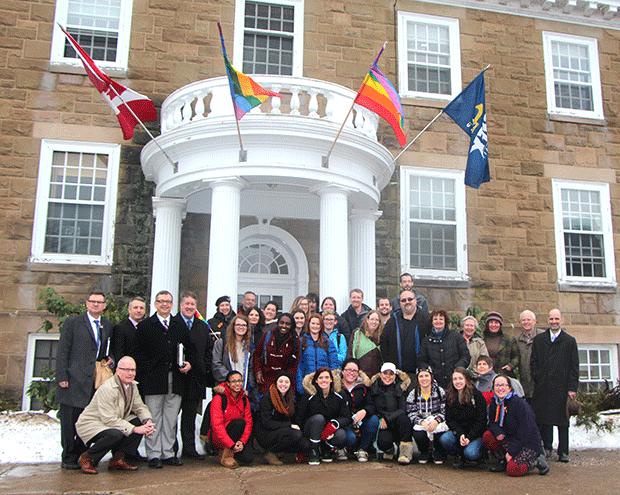
On the evening of Tuesday, February 27, StFX students, faculty, and community members, gathered in the Schwartz building to participate in the third contextualizing lecture of the school year. The lecture series, hosted by the StFX History Department, invites panelists to discuss and contextualize current issues. The series draws on historical narratives and how they continue to shape and be in conversation with modern issues and topics today.

The third lecture, that myself and many others were privy to on Tuesday night, worked to critically contextualize white supremacy. White supremacy describes the dominance and power that white people have held over other races throughout history. Although all white people benefit from white privilege to some degree, not all white people are white supremacists. Those who self-identify specifically as white supremacists, however, believe that white people are inherently superior to people of colour and therefore should continue to dominate society. In the wake of the massacre that took place in a Florida high school last month, that was initiated by a young man who had ties with neo-nazi groups, as well as the debate that was sparked locally about the removal of the Cornwallis statue in Halifax, the lecture came in a very timely manner.

The lecture was hosted by history professor Chris Frazer, who welcomed panelists Dr. Robert Zecker, who has been teaching in the Department of History since 2002; Dr. Ronald Charles who works in the Department of Religious Studies; and Dr. Donna Trembinski, who focuses her research and teaching in medieval history.

Each panelist had a unique and tremendously important perspective to bring to the discussion of white supremacy. Dr. Trembinski discussed how and why medieval symbolism is being used by white supremacists, like the symbols present at the Charlottesville riots that occurred in August. She indicated that the presence of these symbols shook her department nationally and they have since been working to deconstruct the ways in which the teaching of Medieval Studies works to perpetuate white supremacy.

Dr. Trembinski discussed how often times the narratives of people of colour are ignored or silenced in the study. Many prominent figures in the medieval era were, in fact, people with African backgrounds but their existence as people of colour are either hidden or white washed by historians. She explained that the medieval world was not homogeneously white and Christian and the fact that it appears as such shows the inherent racism of the teaching of Medieval History in general. Dr. Trembinski reminds us that the past must intersect with the present and commits that herself and other educators are working to change racist narratives and promote the truth of these histories in order to combat the perpetuation of white supremacy in our modern world.

Dr. Charles followed by discussing racism and white supremacy in religious, particularly Christian, thought. He points to the story of the curse of Ham that appears in Genesis in the Bible and how it is often used to perpetuate ideas about black inferiority. Some believe that this story promotes the idea that blackness is a curse and black people are meant to be enslaved. Dr. Charles points out that this narrative, along with many other white, Christian stories were and continually are, used by white people to undermine the rights and equal existence of black people.

The panelists explained that white supremacy, Christianity and colonialism are all inherently and historically linked because we teach our history from the top down. We do not inquire about the experiences and histories of marginalized groups and we continue to neglect to do so. Dr. Charles explained that some Christians continually use the Bible and religion to justify acts of racism and the perpetuation of white supremacy. The narratives in the Bible of superiority and domination continue to shape the ways in which we interact with those who are different from ourselves. Dr. Charles reminds us that while we may accept certain aspects of religious texts, we must reject problematic aspects and that we must continue to think critically about what we read if we wish to deconstruct systems that allow some to succeed on the backs of others.

Dr. Zecker looked to White Supremacy in U.S. history and reminded us of all the times that we thought we had made progress just to find out that racism still indeed thrives in our societies. The narratives that promote racism as yesterday’s news do not allow us to critically analyze the moment we currently find ourselves in and respond to issues in the right context. Dr. Zecker points out that, in this day and age, we are continuing to accept and legitimize white terrorism that we have seen acted on in recent events. He also points to an interesting pattern wherein after moments of black success, the United States has continually seen a rise of racist groups.

In Dr. Zecker’s perspective, the Trump administration is helping to normalize and allow for white supremacist groups to be legitimate. Black achievement, Zecker highlights, has always been a threat to white dominance and supremacy and we thus must not equate black success to the deterioration of racism because they often go hand-in-hand. The presence and glorification of statues of men who have committed heinous and racist crimes and the “debate” over whether to remove them shows that we do still have a long way to go in dealing with racist histories in order to promote more tolerance and respect into the future.

The discussion that ensued after the panel was very powerful and interesting. Those present worked to put white supremacy into a Canadian context and discuss the issues faced by black people and indigenous people in our country as well as those who continue to allow racism to exist and make up so much of our Canadian narrative today. The panelists worked with listeners to suggest ways to combat white supremacy in our day to day lives by centering the stories and ideas around those who are marginalized and promoting the power and leadership of people of colour. The existence of these difficult but candid discussions is also a step in this direction.

This is the final contextualizing lecture of the year but there are many events occurring this week for International Women’s Week that will also be working to spark progressive and activist conversation on campus. For more information, please be sure to seek out the Women’s Week Facebook pages.
 

Making Better Opportunities for Women in the Work Force


 Breaking the barriers for women

The Liberal Party of Canada has started pushing the envelope of gender equality in the workforce and equal pay in 2018, and their other focus has been narrowing the gender pay gap.

Within their focus of gender equality in the work force, the Liberals have extended the budget for parental leave.

Bill Morneau, the Minster of Finance, made a comment in Parliament that while it’s excellent to see all the women that have been entering the workforce and adding to the Canadian economy, there are still barriers that block women from success in the workforce.

Just last month, the Liberal Party extended the budget for parental leave from 35 weeks to 40 weeks to help with those barriers that women face. 

The hope is that with the extended leave, the second parent involved with raising the child will enable the mother to get back into the workforce sooner and have the other parent look after the child with the extra 5-week extended period.

In an interview with CBC, a parent by the name of Yulanda Julien stated that the extended parental leave “would have helped our entire family.”

Julien continued to say that this extended pay would have allowed him to stay in the house longer to help raise his child, adding that fathers also play a vital role in a child's upbringing.

However, even with the great news and plans that the Liberal Party have for women in the workforce, there seems to be a missed opportunity to make an even bigger change. 

The Liberal Party did extend the parental leave, but the Employment Insurance (EI) benefits were not raised, which can cause issues for parents that are taking the time off for this leave.

Right now, the EI benefits are 55 cents to each dollar of the eligible earnings for the parents that choose the 12-month parental leave. But, for the couples that will go with the new 18-month leave, they will only be getting 33% of eligible earnings.

While the Liberal Party is making the workforce more accessible for women in terms of parental leave, they are also now trying to make the gender pay gap smaller.

Bill Morneau said that they have been working tirelessly to bridge the 12 cent hourly pay gap that still exists between men and women that work full time.

It’s a very exciting time for women in Canada. Finally their pleas for gender equality are being listened to. The new implements that are being put in place might seem small, but they are the step forward that women have been looking for. 

There is still a long way to go for women in the work sector in Canada, but the Liberal Party is making it clear that they want to work with the women of this country in order to fully fulfill gender equity. 


StFX student sends medical supplies to clinics across the globe


Alec Cranston is doing his part by helping one clinic at a time

For the past year, StFX student Alec Cranston has been packing suitcases and handing them off to local travellers, in hopes of spreading the wealth of Canadian medical supplies to countries who lack such resources.

Cranston is a member of an organization called Not Just Tourists. It began in Canada and, over the years, has collected surplus medical supplies across the country, in order to deliver them to medical clinics and hospitals in need around the world. The organization was developed in order to end the desperate need for supplies across the globe.

The organization, which was founded in 1990 by Dr. Ken Taylor and his wife, Denise Taylor, has been making deliveries over the past few decades. It all began when the couple had gone on a trip to Cuba and experienced Cuba’s medical supply shortage firsthand. The two decided that they needed to do something and bringing medical supplies to countries such as Cuba seemed like the perfect step forward.

The organization is run across Canada by volunteers like Cranston, who want to make a difference when it comes to the shortage of global medical supplies.

Cranston has spent his past two summers working at a hospital in Halifax, Nova Scotia and explained how “the amount of medical supplies that goes to waste is horrifying”. He stated that he has always wanted to get involved with relief aid and helping other countries.

Over the past 25 years, with no funding, the entirely volunteer-driven organization has delivered over 10,000 suitcases to 82 countries around the world.

Cranston has been able to add to that number with several successful deliveries. He joined in May of 2017 and is now one of only two Not Just Tourists representatives in Nova Scotia. His role with the organization is to collect the supplies, organize it and pack it into suitcases.

He explained that the goal is to have people who are planning a vacation or travelling for business to sign up and take a bag with them for their visit. It seems simple, but of course there are setbacks and having people take the bags “is the hardest part”, as it doesn’t always work going through customs or other such challenges are presented.

But when it does work, the results have shown to be very beneficial. Successful places that Cranston has been a part of include multiple trips to Cuba, Ghana, the Dominican Republic, Nicaragua and Puerto Rico.

When asked how someone goes about delivering the supplies, Cranston explained “sometimes we have clinics that are registered, but if not, we can leave it up to the person to choose where they want to go”. For this reason, it can make deliveries easy for the travellers with time restrictions. Cranston told us that he would supply the traveller with a list of clinics near the airport, or on the traveller’s route so that they can access the nearest location for lack of time, or so that the traveller can choose where they would like to make the delivery. It provides them with “the freedom of choice” so that person can make the decision on their own and maybe even create a connection with that place.

As Canadians, Cranston explained we are “well supplied and well-funded by the government and have strong trade agreements, that these other countries just don’t have.” This means we will never be at a loss for supplies and doctors will not have to choose one person over another when it comes to distributing supplies to patients. Cranston ended by stating that a lot of these countries, like Cuba, have really great health care systems, but are just lacking the source of supplies.


Maclean's Magazine makes statement on gender wage gap


Maclean’s Magazine, an already controversial publication by StFX standards due to its constant ranking of the university and its party culture, has just gotten a whole lot more controversial. Their March 2018 issue has been created with two different versions. The content of the magazine is identical in every way, however one version has a cover that reads “Men pay 6.99 8.81 for this magazine” while the other reads “Women pay 6.99 8.81 for this magazine”, with a barcode for each price that is either covered or revealed with the corresponding price point.

Maclean’s anticipated upset around their decision, and for obvious reasons; why is it okay to offer the same product but at a difference of 1.82, based on the sole qualification of gender? It seems ridiculous and sexist to apply this principle and disadvantage a distinct group arbitrarily. And it is right that it seems this way, because that was exactly the purpose of Maclean’s in doing this.

Below the prices is a statement of intent surrounding the issue, which reads, “The prices reflect the shocking 26 per cent pay equity gap that still exists in Canada.” MacLean’s created the issue with separate prices in order to firmly call attention to the pay disparity that exists between men and women.” Inside is an article explaining their position on the point, however the purpose of the issue was not just to educate, but to provoke. It was not enough for Maclean’s to include information on the subject; rather, they wanted to create real change by giving readers the lived experience of what it means to have a difference in pay. A difference in earnings leads to a difference in purchasing power, reflected in the different prices on offer.

The internal article explaining their position on the matter, cites the #MeToo movement and how impactful it has been. Maclean’s views the pay equity gap as the next obstacle to tackle as part of this viral thread.

And Maclean’s isn’t the first group to highlight this disparity, as they themselves note.

According to the Canadian Women’s Foundation, there is cause for such demonstrations to take place. As of 2014, Canada was the country with the 7th highest gender wage gap. Traditional “women’s work” tends to pay less, and women are more likely to work part-time jobs, contributing to this figure. However, about 10-15 per cent of the wage gap is attributed to discrimination.

 Maclean’s, in creating this very noticeable issue, starkly contrasted in black and yellow, calls attention to this extremely relevant topic. As their article concludes, women should expect nothing less than to receive equal pay for equal work. Maclean’s is merely attempting to bring greater attention to women’s worthy cause.